Table of Contents
- Introduction
- What is a Fabric Roller?
- Why Fabric Rollers are Important in Composite Manufacturing
- Key Features of SR Composites Fabric Roller
- Benefits of Using a Fabric Roller
- Applications of Fabric Rollers
- FAQs
- Conclusion
Introduction
Discover how SR Composites Fabric Rollers improve composite manufacturing with smooth finishes, enhanced adhesion, reduced manual effort, and increased productivity. Ideal for FRP, fiberglass, marine, automotive, and industrial applications.
In the world of composite manufacturing, achieving a smooth, durable, and professional finish is essential for producing high-quality products. Whether you are working with fiberglass, carbon fiber, or other composite materials, proper resin distribution and fabric consolidation play a crucial role in the final outcome.
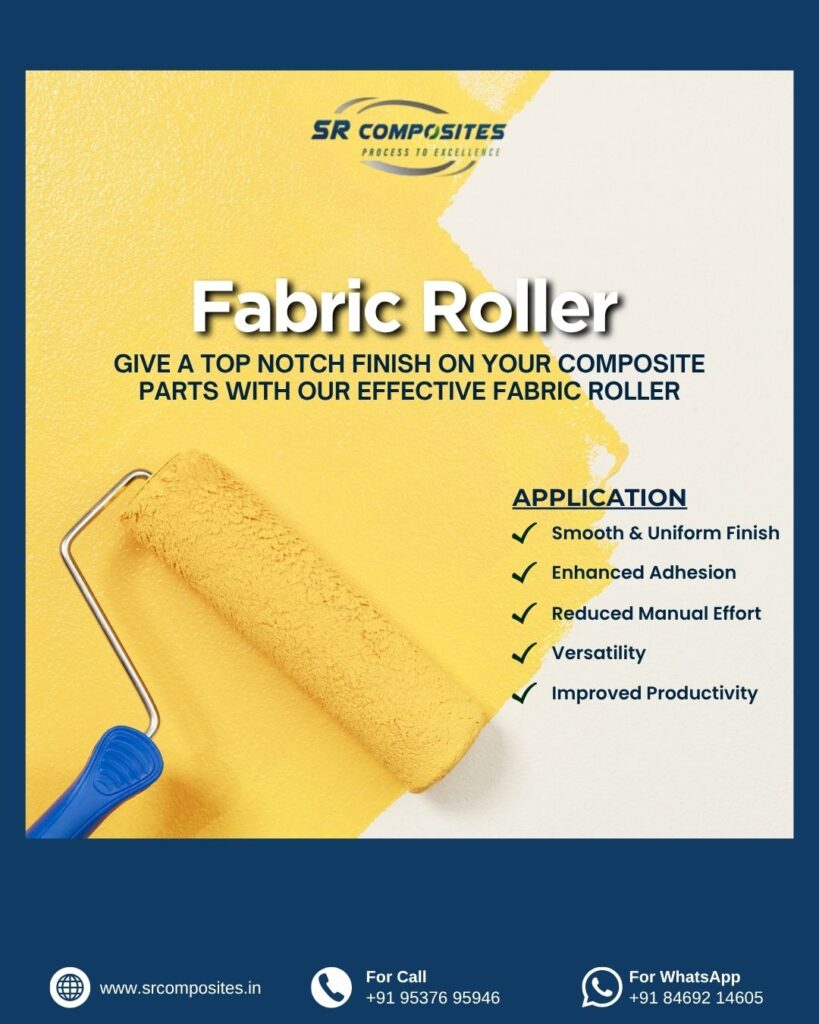
A Fabric Roller is one of the most effective tools used during the lamination process. Designed to provide a smooth and uniform finish, it helps manufacturers improve adhesion, reduce manual effort, and increase productivity. SR Composites offers high-quality Fabric Rollers engineered to deliver reliable performance across a wide range of composite applications.
What is a Fabric Roller?
A Fabric Roller is a specialized tool used in composite fabrication and fiberglass lamination processes. It is designed to apply pressure evenly across composite fabrics, helping resin penetrate effectively while removing trapped air bubbles. This ensures proper bonding between layers and results in stronger, more durable composite parts.
The roller helps achieve a consistent finish while reducing imperfections that can affect the structural integrity and appearance of the final product.
| Feature | Description |
|---|---|
| Product Name | Fabric Roller |
| Brand | SR Composites |
| Primary Use | Composite Lamination & Surface Finishing |
| Application | FRP, Fiberglass, Carbon Fiber Composites |
| Finish Quality | Smooth & Uniform Finish |
| Key Benefit | Enhanced Adhesion Between Layers |
| Productivity | Improves Manufacturing Efficiency |
| Manual Effort | Reduces Operator Fatigue |
| Industries Served | Marine, Automotive, Aerospace, Industrial |
| Durability | Designed for Long-Term Industrial Use |
Why Fabric Rollers are Important in Composite Manufacturing
Composite manufacturing requires precision and consistency. Uneven resin distribution can lead to weak bonding, air pockets, and surface defects. Fabric Rollers help eliminate these issues by ensuring resin is evenly spread throughout the reinforcement fabric.
Check this:- https://www.indiamart.com/
By improving laminate consolidation and reducing manual effort, Fabric Rollers contribute to higher production efficiency and better product quality.
Key Features of SR Composites Fabric Roller
Smooth & Uniform Finish
Ensures even resin distribution across the composite surface, resulting in a professional-quality finish.
Enhanced Adhesion
Improves bonding between fabric layers and resin systems, increasing strength and durability.
Reduced Manual Effort
Designed for efficient operation, helping reduce labor-intensive work and operator fatigue.
Versatile Applications
Suitable for fiberglass, carbon fiber, FRP components, and various composite manufacturing processes.
Improved Productivity
Speeds up the lamination process and helps manufacturers achieve consistent results with less effort.
Durable Construction
Built using high-quality materials for long-lasting performance in demanding industrial environments.
Benefits of Using a Fabric Roller
Using a Fabric Roller provides several advantages in composite manufacturing:
- Improves surface finish quality.
- Reduces air entrapment and void formation.
- Enhances laminate strength and reliability.
- Ensures consistent resin application.
- Minimizes rework and material wastage.
- Increases operational efficiency.
- Helps achieve professional-grade composite products.
These benefits make Fabric Rollers an essential tool for manufacturers seeking better quality and productivity.
Applications of Fabric Rollers
Fabric Rollers are widely used across various industries, including:
Fiberglass Reinforced Plastic (FRP) Manufacturing
Helps ensure proper resin penetration and laminate consolidation.
Marine Industry
Used in boat building and marine component fabrication.
Automotive Industry
Supports the production of lightweight and high-strength composite parts.
Aerospace Applications
Ensures precision and consistency in advanced composite structures.
Industrial Equipment Manufacturing
Used in tanks, panels, ducts, and other composite products.
Wind Energy Sector
Supports the fabrication of composite components used in wind turbine systems.
Frequently Asked Questions (FAQs)
1. What is the primary purpose of a Fabric Roller?
A Fabric Roller is used to distribute resin evenly, remove trapped air, and improve adhesion during composite manufacturing.
2. Can Fabric Rollers be used with fiberglass materials?
Yes, Fabric Rollers are commonly used with fiberglass and other reinforcement fabrics in FRP manufacturing.
3. How does a Fabric Roller improve composite quality?
It ensures proper resin penetration, reduces air bubbles, and creates a smoother, stronger laminate structure.
4. Are Fabric Rollers suitable for industrial applications?
Absolutely. They are widely used in marine, automotive, aerospace, and industrial composite manufacturing.
5. Why choose SR Composites Fabric Rollers?
SR Composites Fabric Rollers are designed for durability, efficiency, and consistent performance, helping manufacturers achieve superior results.
Conclusion
A Fabric Roller is an indispensable tool in composite manufacturing, helping achieve smooth finishes, improved adhesion, and enhanced productivity. Ensuring proper resin distribution and reducing air entrapment contribute significantly to the strength, appearance, and reliability of composite products.
SR Composites Fabric Rollers are designed to meet the demands of modern manufacturing processes, offering durability, efficiency, and exceptional performance. Whether you are involved in FRP production, marine fabrication, automotive components, or industrial composites, investing in a high-quality Fabric Roller can greatly improve