Table of Contents
- What is Non-Perforated Release Film?
- Key Features of Non-Perforated Release Film
- Benefits of Using Non-Perforated Release Film
- Technical Specifications
- Applications of Non-Perforated Release Film
- Why Choose SR Composites Non-Perforated Release Film?
- Best Practices for Usage
- Frequently Asked Questions
- Conclusion
Non-Perforated Release Film is a specialized consumable material widely used in SR Composite manufacturing and vacuum bagging processes. Designed to create a clean separation between composite laminates and auxiliary materials, it prevents unwanted bonding while maintaining an exceptionally smooth surface finish.
Unlike perforated films that allow resin bleed-through, Non-Perforated Release Film creates a complete barrier, helping manufacturers retain resin within the laminate structure. This results in improved mechanical properties, better surface aesthetics, and greater process control.
For industries where precision and quality are critical, such as aerospace, automotive, marine, wind energy, and industrial composites, Non-Perforated Release Film plays a vital role in achieving consistent and reliable results.
What is Non-Perforated Release Film?
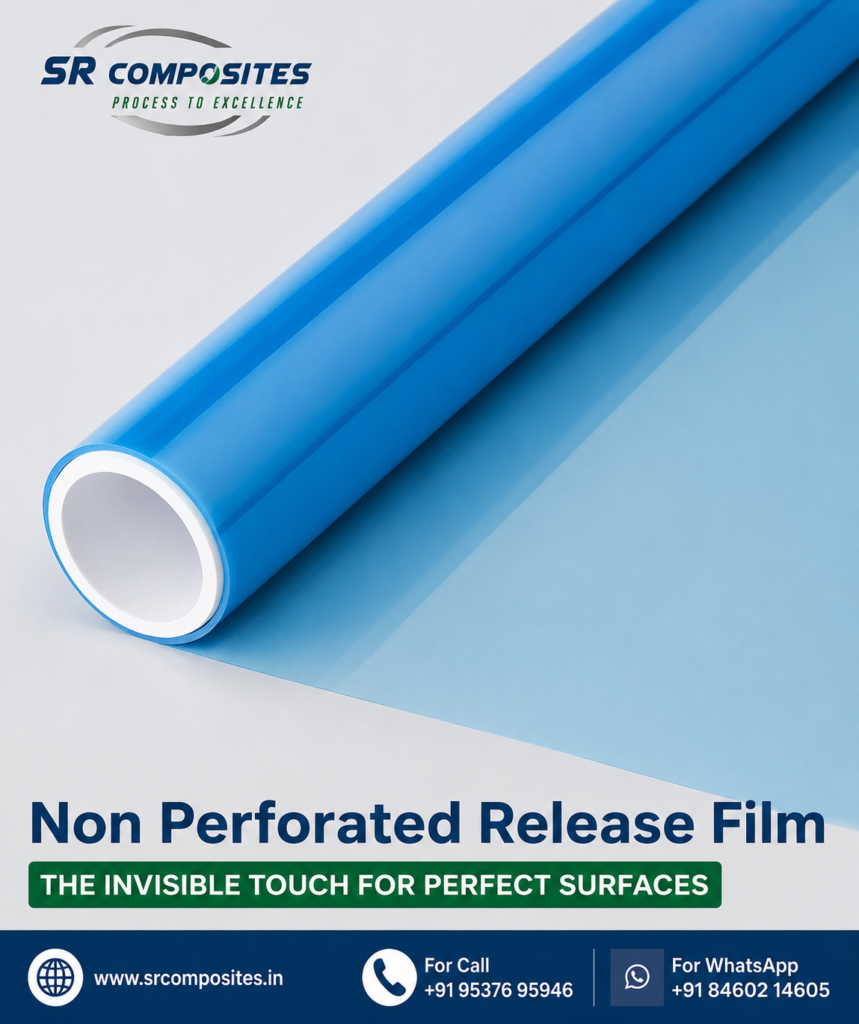
Non-Perforated Release Film is a thin polymer-based film designed for composite layup and vacuum bagging applications. The film acts as a separation layer between the laminate and other vacuum bagging materials, preventing adhesion while preserving surface quality.
Since the film contains no perforations, resin remains within the laminate rather than bleeding into breather or absorber layers. This characteristic makes it ideal for applications requiring precise resin retention and superior surface finish.
Key Features of Non-Perforated Release Film
Complete Resin Barrier
Prevents resin flow through the film, ensuring maximum resin retention within the laminate.
Excellent Release Properties
Allows easy removal after curing without damaging the composite surface.
Smooth Surface Finish
Produces high-quality cosmetic surfaces with minimal defects.
High Temperature Resistance
Suitable for elevated-temperature curing processes commonly used in advanced composites.
Chemical Compatibility
Compatible with a wide range of epoxy, polyester, vinyl ester, and other resin systems.
Consistent Thickness
Provides uniform performance throughout the manufacturing process.
Easy Handling
Flexible and lightweight design simplifies application and removal.
Benefits of Using Non-Perforated Release Film
Improved Composite Quality
Maintains the desired resin content, resulting in stronger and more durable composite parts.
Superior Surface Appearance
Creates smooth and defect-free surfaces that require less post-processing.
Reduced Material Waste
Minimizes resin loss and improves production efficiency.
Enhanced Process Control
Provides greater consistency across manufacturing batches.
Increased Productivity
Simplifies demolding and reduces cleanup time after curing.
Cost Efficiency
Helps manufacturers reduce material consumption and rework costs.
Technical Specifications
| Property | Description |
|---|---|
| Product Type | Non-Perforated Release Film |
| Material | High-Performance Polymer Film |
| Surface Finish | Smooth |
| Perforation | None |
| Temperature Resistance | High Temperature Compatible |
| Resin Compatibility | Epoxy, Polyester, Vinyl Ester |
| Application Method | Vacuum Bagging & Composite Layup |
| Removal | Easy Release After Cure |
Applications of Non-Perforated Release Film
Aerospace Components
Used in aircraft structures and high-performance composite parts requiring precise resin control.
Automotive Manufacturing
Supports the production of lightweight and durable automotive composite components.
Marine Industry
Ideal for boat hulls, decks, and structural marine composite applications.
Wind Energy
Used in wind turbine blade manufacturing where consistency and strength are critical.
Industrial Composite Parts
Suitable for panels, tooling, tanks, pipes, and custom composite structures.
Sports & Recreation Equipment
Applied in the production of bicycles, sporting goods, and high-performance recreational products.
Why Choose SR Composites Non-Perforated Release Film?
Premium Manufacturing Standards
Produced using high-quality materials and advanced manufacturing processes.
Reliable Performance
Ensures consistent release characteristics and surface quality.
Industry Expertise
Backed by extensive experience in composite consumable solutions.
Wide Application Range
Suitable for multiple industries and manufacturing processes.
Customer-Focused Support
Technical guidance and product assistance for optimal results.
Best Practices for Usage
Clean the Mold Surface
Ensure the mold is free from dust, moisture, and contaminants.
Apply Film Correctly
Position the film smoothly to avoid wrinkles and air pockets.
Maintain Proper Vacuum Pressure
Use recommended vacuum settings for optimal laminate consolidation.
Follow Cure Cycle Requirements
Adhere to resin manufacturer guidelines for temperature and curing duration.
Inspect After Demolding
Check surface quality and ensure proper release performance.
Frequently Asked Questions (FAQs)
What is the purpose of a Non-Perforated Release Film?
It prevents adhesion between composite laminates and vacuum bagging materials while retaining resin within the laminate.
How is it different from a perforated release film?
A non-perforated film blocks resin flow completely, whereas perforated films allow controlled resin bleed.
Which resins are compatible with this film?
It is generally compatible with epoxy, polyester, and vinyl ester resin systems.
Can it be used in high-temperature curing processes?
Yes, it is designed to withstand elevated curing temperatures commonly used in composite manufacturing.
Does it improve surface finish?
Yes, it helps create smoother and cleaner composite surfaces with minimal defects.
Is it suitable for aerospace applications?
Yes, it is widely used in aerospace composite manufacturing where quality and consistency are essential.
Can it reduce production costs?
Yes, by minimizing resin loss, reducing rework, and improving process efficiency.
Is the film easy to remove after curing?
Yes, it is specifically engineered for easy release after the curing process.
Conclusion
Non-Perforated Release Film is an essential component in modern composite manufacturing. By providing excellent release characteristics, superior resin retention, and outstanding surface finish, it helps manufacturers achieve higher-quality composite parts with greater efficiency.
Whether used in aerospace, automotive, marine, wind energy, or industrial applications, Non-Perforated Release Film delivers reliable performance and process consistency. Choosing a premium-quality solution from SR Composites ensures improved productivity, reduced waste, and exceptional finished products that meet demanding industry standards.
Check this :- https://www.indiamart.com/