Table of Contents
- Introduction to Perforated Release Film
- What is Perforated Release Film?
- Key Features of Perforated Release Film
- Technical Specifications Table
- Benefits of Using Perforated Release Film
- Applications of Perforated Release Film
- Perforated Release Film in Vacuum Infusion Processes
- How to Choose the Right Perforated Release Film
- Best Practices for Installation and Use
- Industries That Rely on Perforated Release Film
- Comparison with Other Release Materials
- Frequently Asked Questions
- Conclusion
Introduction to Perforated Release Film
SR Composite manufacturing requires precision, consistency, and high-quality surface finishes. One of the most critical materials used during vacuum infusion and composite lamination is Perforated Release Film. This specialized film helps regulate resin flow, prevents bonding between layers, and ensures easy separation after curing.
Whether used in aerospace, marine, automotive, wind energy, or industrial composite applications, perforated release films contribute significantly to achieving professional-grade composite surfaces while reducing manufacturing defects.
What is Perforated Release Film?
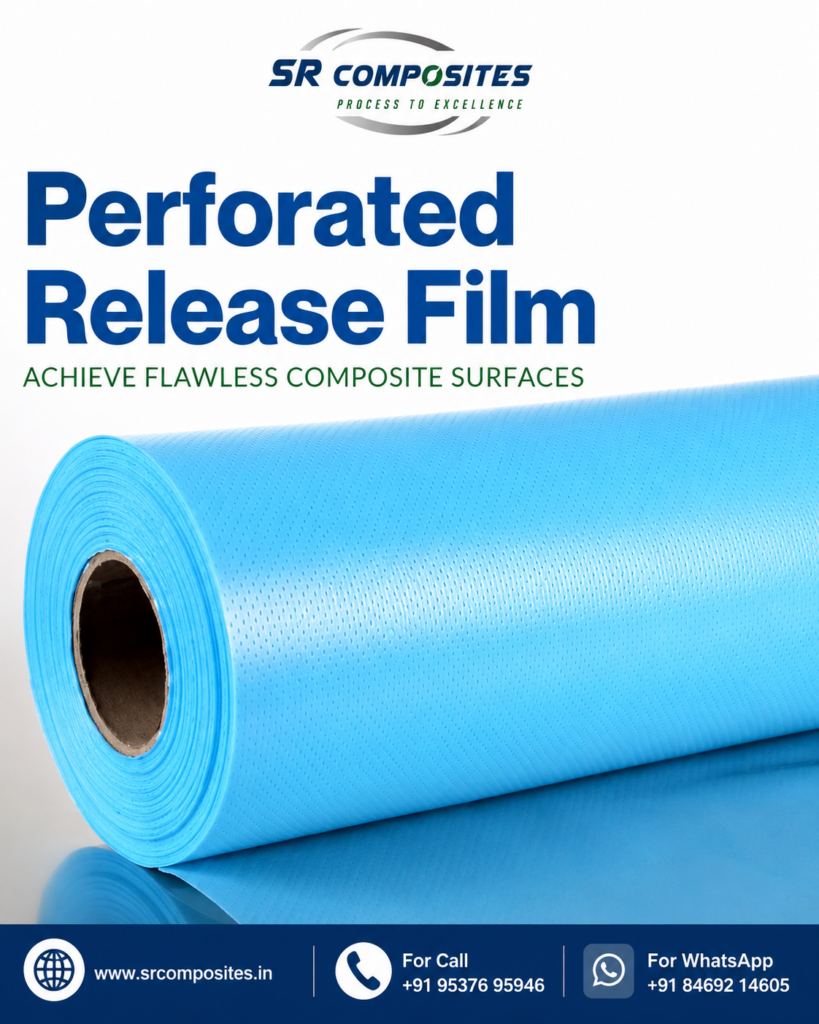
Perforated Release Film is a thin polymer-based film containing precisely engineered holes or perforations. It is placed between the laminate and absorbent breather materials during composite manufacturing.
The perforations allow excess resin to pass through in a controlled manner while preventing unwanted adhesion between layers. This controlled resin management helps create uniform laminate thickness and superior surface quality.
Key Features of Perforated Release Film
Controlled Resin Bleeding
Designed perforations enable excess resin to move through the film efficiently, ensuring optimal fiber-to-resin ratios.
Excellent Release Properties
Provides clean separation from composite laminates after the curing process.
Consistent Surface Finish
Helps achieve smooth, professional-quality composite surfaces.
Temperature Resistance
Suitable for high-temperature curing applications commonly used in advanced composite manufacturing.
Chemical Compatibility
Compatible with epoxy, polyester, vinyl ester, and various resin systems.
Easy Handling
Lightweight, flexible, and simple to install during vacuum bagging processes.
Technical Specifications Table
| Property | Description |
|---|---|
| Material | Polymer-Based Release Film |
| Surface Type | Smooth and Uniform |
| Perforation Options | Multiple Hole Patterns |
| Temperature Resistance | High Temperature Compatible |
| Resin Compatibility | Epoxy, Polyester, Vinyl Ester |
| Application Method | Vacuum Bagging & Infusion |
| Removal | Easy Peel-Off After Cure |
| Industry Use | Aerospace, Marine, Automotive |
Benefits of Using Perforated Release Film
Improved Resin Distribution
Perforations allow controlled resin movement, helping create stronger and more consistent laminates.
Enhanced Surface Quality
Reduces imperfections and improves the final component appearance.
Easier Demolding
The release film prevents direct bonding, making part removal quick and efficient.
Reduced Material Waste
Optimized resin flow helps minimize excess resin usage.
Increased Manufacturing Efficiency
Faster production cycles and reduced cleanup requirements improve productivity.
Better Composite Performance
Consistent resin content contributes to stronger, lighter, and more reliable composite structures.
Applications of Perforated Release Film
Vacuum Infusion Processes
Widely used in vacuum infusion systems to manage resin flow during laminate fabrication.
Aerospace Components
Supports high-performance aerospace structures requiring precision manufacturing.
Marine Structures
Used in boat hulls, decks, and marine composite components.
Automotive Parts
Helps produce lightweight automotive panels and structural components.
Wind Energy Blades
Supports large-scale composite blade manufacturing.
Industrial Composite Products
Used in tanks, pipes, panels, and various industrial composite applications.
Perforated Release Film in Vacuum Infusion Processes
Vacuum infusion is one of the most popular composite manufacturing techniques. During this process, perforated release film acts as an intermediary layer between the laminate and breather fabric.
Its perforations control how much resin passes through during vacuum pressure application. This ensures:
- Consistent laminate quality
- Reduced void formation
- Improved structural performance
- Better fiber wet-out
- Enhanced surface finish
The result is a high-quality composite part with excellent mechanical properties.
How to Choose the Right Perforated Release Film
Selecting the correct release film depends on several factors:
Resin System
Ensure compatibility with epoxy, polyester, or vinyl ester resins.
Cure Temperature
Choose a film rated for your processing temperature.
Perforation Pattern
Different perforation sizes affect resin flow rates.
Surface Finish Requirements
Select a film that meets desired finish quality specifications.
Part Complexity
Complex molds may require more flexible release films.
Best Practices for Installation and Use
Prepare the Mold Properly
Ensure clean mold surfaces before layup.
Position Film Correctly
Place the release film evenly across the laminate surface.
Avoid Wrinkles
Smooth application prevents resin flow inconsistencies.
Select Suitable Breather Materials
Combine with appropriate breather fabrics for optimal performance.
Monitor Vacuum Levels
Maintain consistent vacuum pressure throughout curing.
Industries That Rely on Perforated Release Film
Aerospace Industry
Aircraft structures and lightweight composite components.
Marine Industry
Boat manufacturing and marine infrastructure.
Automotive Industry
Lightweight vehicle panels and performance components.
Renewable Energy Sector
Wind turbine blade manufacturing.
Construction Industry
Architectural composite panels and advanced building materials.
Comparison with Other Release Materials
| Feature | Perforated Release Film | Non-Perforated Release Film |
|---|---|---|
| Resin Control | Excellent | Limited |
| Surface Finish | High Quality | Good |
| Resin Bleeding | Controlled | Minimal |
| Vacuum Infusion Use | Ideal | Limited |
| Composite Consistency | Excellent | Moderate |
| Production Efficiency | High | Moderate |
Frequently Asked Questions
What is the purpose of perforated release film?
It controls resin flow, prevents sticking, and improves composite surface quality during manufacturing.
Can perforated release film be used with epoxy resin?
Yes, it is commonly used with epoxy, polyester, and vinyl ester resin systems.
Is perforated release film reusable?
Most release films are designed for single-use applications to ensure consistent performance.
Which industries use perforated release film?
Aerospace, marine, automotive, renewable energy, and industrial manufacturing sectors extensively use it.
How does perforation size affect performance?
Different perforation sizes regulate resin bleed rates and influence final laminate properties.
Does perforated release film improve composite quality?
Yes, it helps achieve better resin distribution, smoother surfaces, and stronger laminates.
Conclusion
Perforated Release Film plays a vital role in modern composite manufacturing by ensuring controlled resin flow, easy release, and exceptional surface quality. Its ability to optimize vacuum infusion and lamination processes makes it an essential material for aerospace, marine, automotive, wind energy, and industrial applications.
Check this :- https://heavyindustries.gov.in/
Manufacturers seeking superior composite performance, improved productivity, and consistent results can greatly benefit from incorporating high-quality perforated release films into their production processes.