Table of Contents
- Introduction
- What is Polyester Peel Ply?
- Key Features of Polyester Peel Ply
- Benefits of Using Polyester Peel Ply
- Applications of Polyester Peel Ply
- Technical Specifications
- How Polyester Peel Ply Works
- Why Choose Polyester Peel Ply for Composite Manufacturing?
- Storage and Handling Guidelines
- Frequently Asked Questions
- Conclusion
Introduction
Polyester Peel Ply is an essential material used in SR composite manufacturing processes to achieve clean, textured, and bond-ready surfaces. It is commonly applied during vacuum bagging and resin infusion processes, helping manufacturers reduce surface preparation time while improving the quality of the finished composite part.
By creating a controlled surface texture after removal, Polyester Peel Ply eliminates the need for extensive sanding and grinding, making production more efficient and cost-effective. Industries such as aerospace, marine, automotive, wind energy, and FRP fabrication widely rely on peel ply fabrics to enhance bonding performance and surface consistency.
What is Polyester Peel Ply?
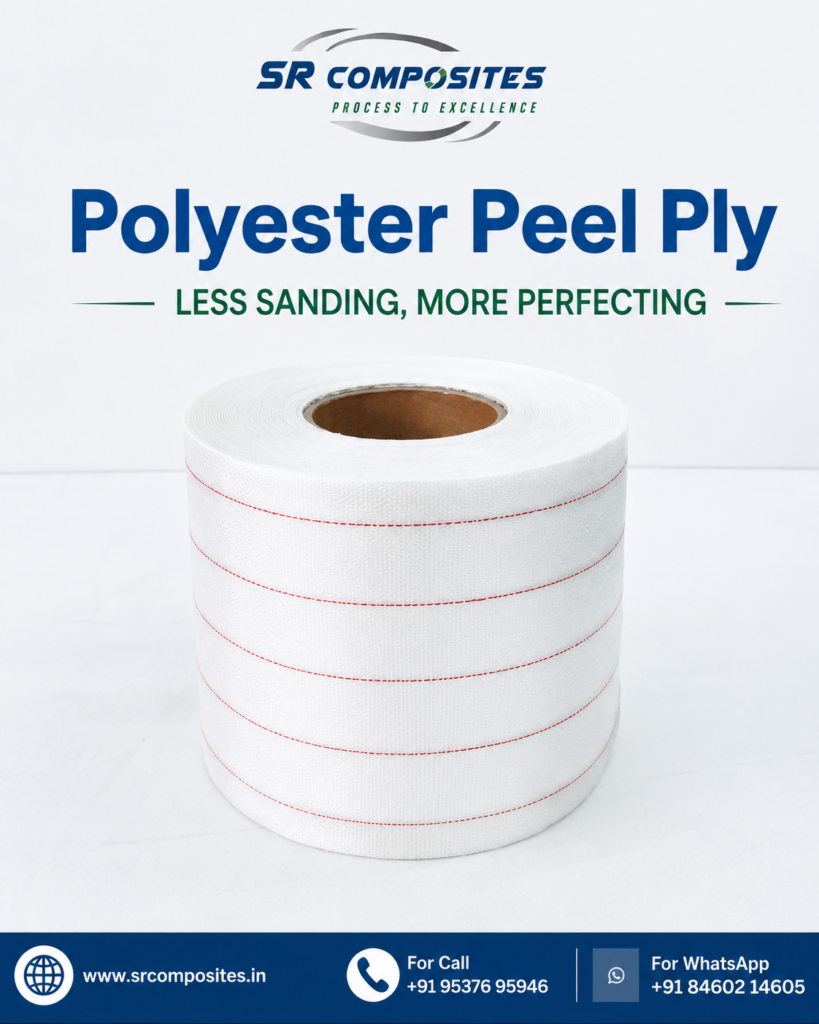
Polyester Peel Ply is a tightly woven synthetic fabric designed to be placed over composite laminates during manufacturing. After the resin cures, the fabric is peeled away, leaving behind a clean and textured surface that is ideal for secondary bonding, painting, or coating applications.
Unlike traditional finishing methods that require extensive sanding, peel ply simplifies the preparation process while ensuring a uniform finish across the entire composite component.
Key Features of Polyester Peel Ply
Excellent Surface Preparation
Creates a bond-ready surface after removal.
Reduces Sanding Requirements
Minimizes labor-intensive surface finishing work.
Easy Removal
Designed to peel away cleanly without damaging the laminate.
High Durability
Maintains structural integrity during resin curing processes.
Consistent Fabric Structure
Provides uniform surface texture for reliable bonding.
Compatible with Various Resin Systems
Works effectively with polyester, epoxy, and vinyl ester resins.
Benefits of Using Polyester Peel Ply
Saves Production Time
Reduces the need for manual sanding and surface preparation.
Improves Bond Strength
Creates an optimal surface profile for secondary bonding operations.
Enhances Surface Quality
Produces cleaner and more consistent composite finishes.
Reduces Manufacturing Costs
Lower labor requirements contribute to overall cost savings.
Supports Efficient Workflow
Speeds up production cycles in composite fabrication facilities.
Minimizes Surface Contamination
Protects laminate surfaces during curing and handling.
Applications of Polyester Peel Ply
Aerospace Industry
Used in aircraft composite structures requiring precision bonding.
Marine Industry
Applied to boat hulls, decks, and fiberglass components.
Automotive Industry
Used for lightweight composite panels and structural parts.
Wind Energy Sector
Supports blade manufacturing and composite assembly processes.
FRP Manufacturing
Widely used in fiberglass-reinforced plastic fabrication.
Industrial Composite Components
Suitable for tanks, pipes, panels, and custom composite products.
Technical Specifications
| Property | Description |
|---|---|
| Product Type | Polyester Peel Ply |
| Material | Woven Polyester Fabric |
| Color | White |
| Resin Compatibility | Polyester, Epoxy, Vinyl Ester |
| Surface Finish | Textured Bonding Surface |
| Application Method | Vacuum Bagging / Hand Lay-Up |
| Removal Type | Easy Peel |
| Industry Use | Composite Manufacturing |
How Polyester Peel Ply Works
Placement on Laminate
The fabric is applied directly over the wet composite laminate.
Resin Curing Process
During curing, the peel ply remains in contact with the composite surface.
Fabric Removal
After full cure, the peel ply is removed by peeling it away from the laminate.
Surface Ready for Bonding
The exposed surface is clean, textured, and ready for secondary operations without additional sanding.
Why Choose Polyester Peel Ply for Composite Manufacturing?
Improved Productivity
Reduces post-processing requirements significantly.
Reliable Surface Consistency
Provides repeatable results across multiple production batches.
Better Adhesion Performance
Enhances bonding effectiveness for structural applications.
Professional Finishing Results
Supports high-quality composite manufacturing standards.
Cost-Effective Solution
Balances performance and affordability for industrial users.
Storage and Handling Guidelines
Store in a Dry Environment
Keep the material away from moisture and humidity.
Protect from Dust
Store in sealed packaging until use.
Avoid Direct Sunlight
Maintain product quality by storing in a cool location.
Handle Carefully
Prevent contamination before application.
Frequently Asked Questions (FAQs)
What is Polyester Peel Ply used for?
Polyester Peel Ply is used to create a clean, textured, and bond-ready surface in composite manufacturing.
Does Polyester Peel Ply eliminate sanding?
In many applications, it significantly reduces or eliminates the need for sanding before secondary bonding.
Can Polyester Peel Ply be used with epoxy resin?
Yes, it is compatible with epoxy, polyester, and vinyl ester resin systems.
Is Polyester Peel Ply reusable?
No, it is generally designed for single-use applications.
Which industries commonly use Polyester Peel Ply?
Aerospace, marine, automotive, wind energy, and FRP manufacturing industries commonly use it.
Does Peel Ply improve bonding strength?
Yes, it creates a textured surface that enhances adhesive bonding performance.
How is Peel Ply removed?
After curing, the fabric is manually peeled away from the composite surface.
Conclusion
Peel ply fabric has become an essential component in modern composite manufacturing because it simplifies surface preparation while improving bonding performance. Its ability to create a clean and uniform texture helps reduce labor costs, minimize finishing work, and enhance production efficiency.
Whether used in aerospace structures, marine components, automotive panels, or FRP products, this composite surface fabric delivers reliable performance and professional-quality results. For manufacturers looking to achieve better adhesion and smoother workflows, peel ply remains a practical and cost-effective solution.
Check this:- https://www.cipet.gov.in/