Table of Contents
- Introduction
- What is a Velour Roller?
- Why Velour Rollers are Essential in Composite Manufacturing
- Key Features of Velour Rollers
- Applications of Velour Rollers
- Benefits of Using a Velour Roller
- Technical Overview
- Industries That Use Velour Rollers
- Best Practices for Effective Roller Application
- Velour Roller vs Traditional Application Methods
- Frequently Asked Questions
- Conclusion
Introduction
Discover the benefits of Velour Rollers in composite manufacturing, resin application, mold coating, air bubble removal, and vacuum infusion processes. Improve surface quality and production efficiency.
In SR composite manufacturing and industrial coating processes, achieving a smooth and uniform finish is critical for product quality and performance. Whether applying resin, gelcoat, topcoat, or mold release systems, the choice of application tool significantly impacts the final result.
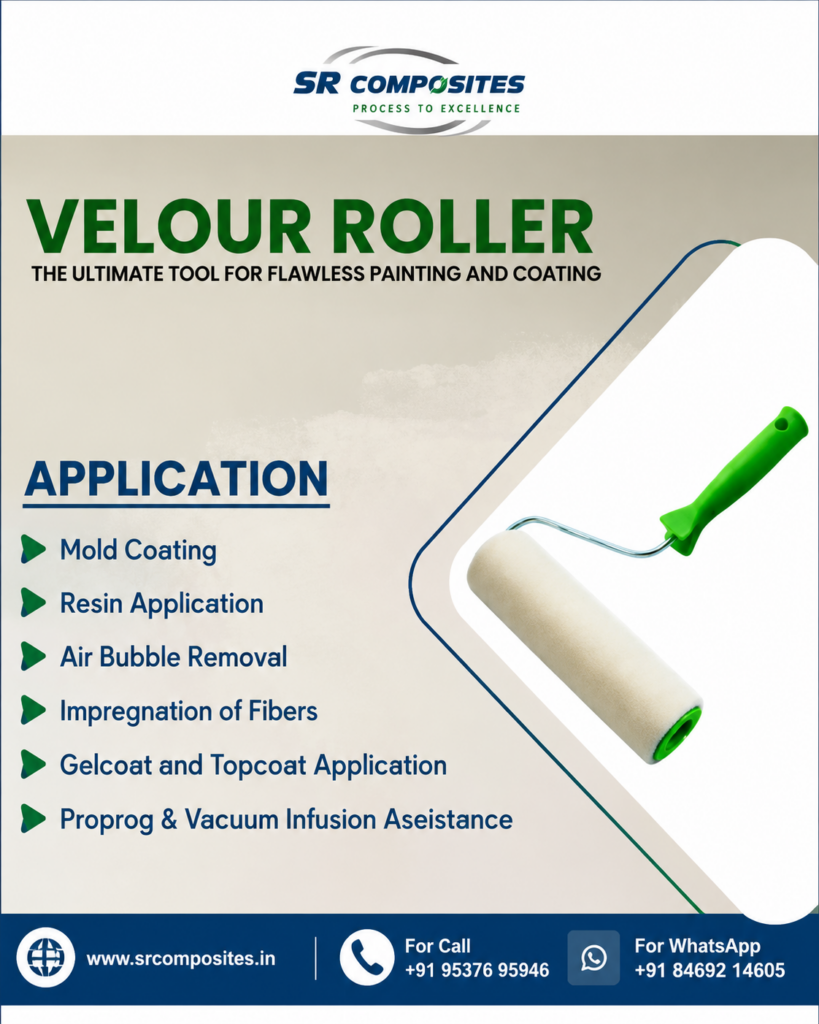
Among the most trusted tools in the composites industry is the Velour Roller. Known for its excellent absorption, smooth application, and ability to minimize air entrapment, the Velour Roller has become an essential tool for professionals working in aerospace, marine, automotive, and industrial composite production.
Its versatility makes it suitable for resin application, mold coating, air bubble removal, fiber impregnation, and vacuum infusion support, helping manufacturers achieve superior surface finishes and improved process efficiency.
What is a Velour Roller?
A Velour Roller is a specialized coating and resin application tool designed with a high-density fabric surface that provides smooth and consistent material distribution.
Unlike standard paint rollers, Velour Rollers are engineered for precision applications in composite manufacturing, where uniform resin coverage and bubble-free surfaces are critical.
The roller’s texture allows it to hold and release materials evenly, reducing defects and improving laminate quality.
Why Velour Rollers are Essential in Composite Manufacturing
Composite manufacturing often requires precise application of resins and coatings to ensure structural integrity and surface quality.
Velour Rollers help manufacturers by:
- Distributing resin evenly.
- Eliminating trapped air bubbles.
- Improving fiber wet-out.
- Reducing surface imperfections.
- Enhancing coating consistency.
- Supporting vacuum infusion processes.
These advantages contribute to stronger, lighter, and more reliable composite components.
Key Features of Velour Rollers
Smooth Material Distribution
Provides consistent application of resin, gelcoat, and topcoat materials.
Excellent Absorption Capacity
Holds sufficient material for continuous application without excessive dripping.
Air Bubble Reduction
Helps remove trapped air during composite layup processes.
Durable Construction
Designed to withstand industrial environments and repeated use.
Lightweight and Easy Handling
Offers improved control and reduced operator fatigue.
Compatible with Multiple Materials
Suitable for resins, coatings, adhesives, gelcoats, and topcoats.
Applications of Velour Rollers
Mold Coating
Ensures uniform mold surface preparation for composite part production.
Resin Application
Provides smooth and even resin distribution during lamination.
Air Bubble Removal
Helps eliminate trapped air that can weaken composite structures.
Fiber Impregnation
Improves resin penetration into reinforcement fibers.
Gelcoat Application
Creates smooth and aesthetically appealing surface finishes.
Topcoat Application
Ensures professional-quality protective coating layers.
Vacuum Infusion Assistance
Supports resin movement and laminate wet-out during infusion processes.
Benefits of Using a Velour Roller
| Benefit | Description |
|---|---|
| Uniform Coating | Consistent material distribution |
| Better Surface Finish | Reduced imperfections and defects |
| Air Bubble Reduction | Improved laminate quality |
| Increased Efficiency | Faster application process |
| Lower Material Waste | Optimized resin utilization |
| Professional Results | High-quality surface appearance |
Technical Overview
| Feature | Specification |
|---|---|
| Product Type | Velour Roller |
| Primary Function | Resin & Coating Application |
| Industries | Composite Manufacturing |
| Applications | Resin, Gelcoat, Topcoat |
| Benefits | Smooth Finish & Air Removal |
| Usage | Manual Application Tool |
Industries That Use Velour Rollers
Aerospace Industry
Used for precision composite manufacturing and structural components.
Marine Industry
Supports boat hull manufacturing and repair applications.
Automotive Industry
Assists in lightweight composite component production.
Wind Energy Sector
Used in turbine blade manufacturing processes.
Industrial Manufacturing
Ideal for coating, reinforcement, and composite fabrication tasks.
Construction Industry
Supports advanced composite and protective coating applications.
Best Practices for Effective Roller Application
Prepare the Surface Properly
Ensure surfaces are clean and free from dust or contaminants.
Apply Even Pressure
Maintain consistent pressure for uniform material distribution.
Use Appropriate Resin Quantities
Avoid overloading the roller with excessive resin.
Work in Controlled Conditions
Maintain recommended temperature and humidity levels.
Clean Equipment After Use
Proper cleaning extends roller lifespan and maintains performance.
Velour Roller vs Traditional Application Methods
| Feature | Velour Roller | Brush Application |
|---|---|---|
| Surface Finish | Excellent | Moderate |
| Air Bubble Removal | Effective | Limited |
| Resin Distribution | Uniform | Variable |
| Speed | Faster | Slower |
| Material Waste | Lower | Higher |
| Professional Finish | High | Medium |
Frequently Asked Questions
What is a Velour Roller used for?
Velour Rollers are used for resin application, mold coating, gelcoat application, topcoat application, and composite manufacturing processes.
Can Velour Rollers remove air bubbles?
Yes. They help eliminate trapped air and improve laminate quality.
Are Velour Rollers suitable for vacuum infusion?
Yes. They assist in resin distribution and fiber wet-out during vacuum infusion processes.
Which industries commonly use Velour Rollers?
Aerospace, marine, automotive, wind energy, industrial manufacturing, and construction industries.
Can Velour Rollers be used with gelcoats and topcoats?
Absolutely. They provide smooth and professional coating application.
Why are Velour Rollers preferred over brushes?
They offer better coverage, reduced material waste, improved finish quality, and faster application.
Conclusion
Velour Rollers are an essential tool in modern composite manufacturing and industrial coating applications. Their ability to provide smooth resin distribution, eliminate air bubbles, improve fiber impregnation, and create high-quality surface finishes makes them a preferred choice across multiple industries.
Check this:- https://www.bis.gov.in/
Whether used for mold coating, resin application, gelcoat finishing, or vacuum infusion support, Velour Rollers deliver superior performance, improved efficiency, and professional results. For manufacturers seeking consistency, reliability, and enhanced product quality, investing in high-quality Velour Rollers is a smart and cost-effective solution.