Vacuum Infusion Mesh: The Key to Consistent and High-Performance Composite Production
Table of Contents
- Introduction
- Understanding Vacuum Infusion Technology
- What Is Vacuum Infusion Mesh?
- How the Material Improves Manufacturing
- Key Advantages in Composite Production
- Applications Across Industries
- Factors to Consider When Choosing Infusion Materials
- Why Choose SR Composites
- Conclusion
- Frequently Asked Questions
Introduction
Vacuum Infusion Mesh plays a critical role in modern composite manufacturing by helping resin travel efficiently throughout reinforcement materials during the vacuum infusion process. As industries increasingly demand lightweight, durable, and high-strength composite structures, manufacturers are turning toward advanced infusion techniques that ensure consistency and precision.
Whether producing marine components, wind turbine blades, automotive panels, or industrial structures, manufacturers need reliable resin distribution to achieve superior product quality. The effectiveness of the infusion process depends heavily on the consumable materials used, and among them, infusion mesh remains one of the most important.
The ability to produce void-free laminates, improve fiber impregnation, and reduce material waste makes this technology a valuable asset in today’s competitive manufacturing environment.
Understanding Vacuum Infusion Technology
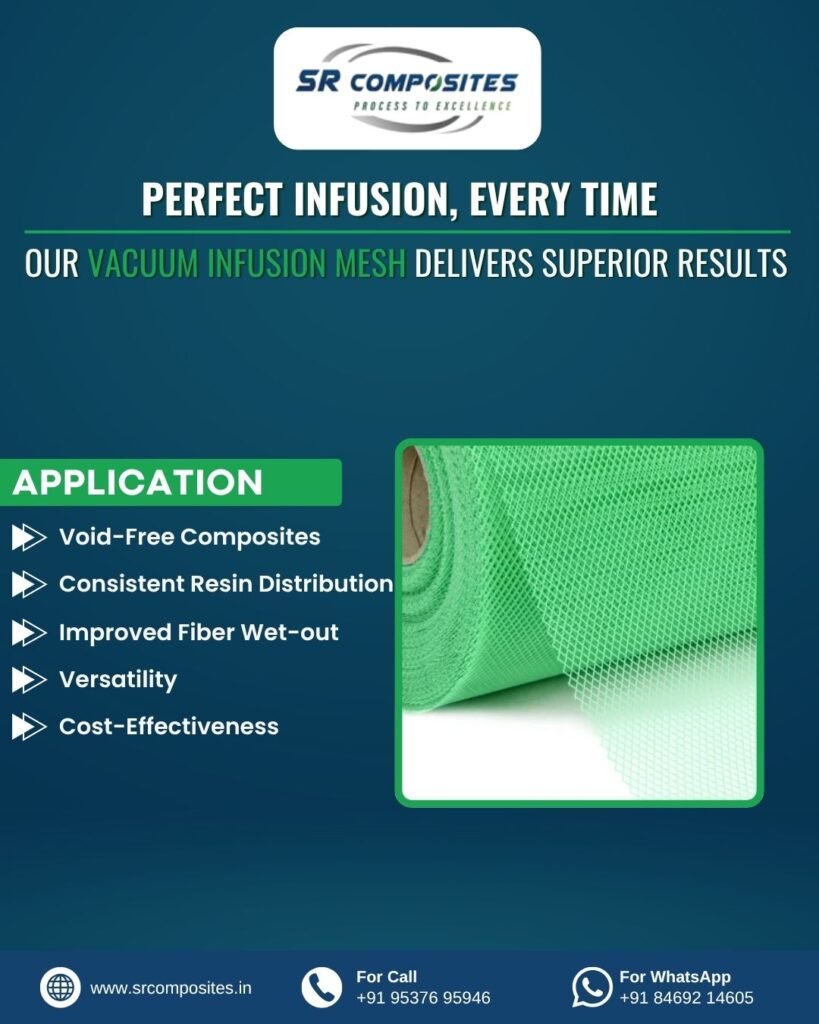
Vacuum Infusion Mesh is a manufacturing process used to produce high-quality composite components. During the process, dry reinforcement materials are placed inside a mold and sealed beneath a vacuum bag. Vacuum pressure removes trapped air and compacts the laminate before resin is introduced.
As resin enters the mold, it must spread uniformly across the entire surface before penetrating the reinforcement layers. Efficient resin movement is essential because uneven flow can create dry spots, trapped air pockets, and structural weaknesses.
This is where specialized flow media become crucial. By providing dedicated channels for resin movement, they help ensure complete laminate saturation and consistent product quality.
What Is Vacuum Infusion Mesh?
Vacuum Infusion Mesh is a lightweight flow media designed to accelerate and control resin distribution during composite manufacturing. Positioned above reinforcement layers and below the vacuum bag, it creates pathways that allow resin to travel quickly across large surfaces.
Instead of relying solely on the natural permeability of reinforcement fabrics, manufacturers use infusion mesh to guide resin flow more effectively. This results in shorter infusion times, improved wet-out, and better laminate consolidation.
The material is widely used in industries where precision, repeatability, and structural performance are essential.
How Vacuum Infusion Mesh Improves Resin Distribution
Vacuum Infusion Mesh. One of the biggest challenges in composite manufacturing is achieving uniform resin distribution throughout the laminate. Uneven flow can create inconsistencies that affect both appearance and mechanical performance.
Infusion mesh creates an efficient network for resin movement, allowing the material to spread evenly before entering the reinforcement layers. This controlled flow minimizes the risk of dry areas and helps manufacturers achieve more predictable results.
Because resin reaches all areas of the laminate more effectively, finished components demonstrate improved strength and reliability.
Better Fiber Wet-Out for Stronger Composites
Fiber wet-out refers to the process of thoroughly impregnating reinforcement materials with resin. Vacuum Infusion Mesh. Incomplete wet-out can weaken a composite structure and reduce its durability.
By improving resin flow characteristics, infusion mesh helps ensure that fibers receive sufficient resin throughout the manufacturing process. Better saturation leads to stronger bonding between fibers and resin, ultimately producing composite parts with enhanced mechanical properties.
Manufacturers often report improved laminate quality and greater consistency when using high-quality infusion materials.
Reduced Voids and Manufacturing Defects
Vacuum Infusion Mesh Air entrapment is a common problem in composite fabrication. Trapped air can create voids that compromise structural integrity and increase the likelihood of product failure.
Efficient resin distribution helps eliminate these issues by allowing resin to replace air more effectively during infusion. As a result, manufacturers can produce cleaner laminates with fewer defects and improved performance.
Lower rejection rates also contribute to significant cost savings over time.
Faster Production and Improved Efficiency
Vacuum Infusion Mesh Production efficiency is a major concern for manufacturers working with large or complex composite structures. Slow resin flow can increase cycle times and reduce overall productivity.
The use of dedicated flow media accelerates resin movement, allowing infusion to be completed more quickly. Faster processing means manufacturers can increase throughput while maintaining strict quality standards.
This advantage becomes particularly valuable when producing large composite components or operating in high-volume manufacturing environments.
Cost Savings Through Process Optimization
Reducing waste is a key objective in any manufacturing operation. Efficient resin distribution helps minimize excess material usage while reducing the likelihood of defective parts.
When infusion processes operate consistently, manufacturers spend less on rework, repairs, and material losses. Over time, these improvements can significantly lower overall production costs.
The result is a more efficient manufacturing process that delivers better value without sacrificing quality.
Industries That Benefit from Infusion Mesh Technology
Marine Manufacturing
Boat builders rely heavily on Vacuum Infusion Mesh processes to create strong and lightweight hulls, decks, and structural components. Controlled resin distribution helps ensure durability and long-term performance in harsh marine environments.
Wind Energy
Large wind turbine blades require precise resin infusion to achieve structural integrity across extensive surfaces. Flow media supports efficient manufacturing and helps maintain consistent quality throughout production.
Automotive Industry
Vehicle manufacturers increasingly use composite materials to reduce weight and improve fuel efficiency. Reliable infusion techniques contribute to the production of strong and lightweight automotive components.
Aerospace Applications
Aircraft structures demand exceptional strength-to-weight ratios and strict quality standards. Advanced infusion systems help manufacturers meet these requirements while maintaining consistency.
Industrial Manufacturing
Numerous industrial products, including tanks, panels, covers, and specialized equipment, benefit from controlled resin infusion and improved laminate quality.
Factors to Consider When Selecting Infusion Materials
Choosing the right infusion solution can significantly impact manufacturing performance. Factors such as flow rate, resin compatibility, durability, and application requirements should be evaluated carefully.
Manufacturers should work with trusted suppliers who understand composite manufacturing and can provide materials designed for consistent performance.
For additional information about composite manufacturing standards and industry developments, manufacturers can refer to the American Composites Manufacturers Association:
https://acmanet.org/
Why Choose SR Composites
At SR Composites, we understand the importance of reliable consumable materials in achieving successful manufacturing outcomes. Our products are designed to support efficient resin flow, improved laminate quality, and consistent production performance.
We supply advanced composite consumables that help manufacturers reduce defects, increase productivity, and achieve superior finished products. Our commitment to quality and customer satisfaction has made us a trusted partner for businesses operating across multiple industries.
Explore our complete range of composite manufacturing solutions at:
Whether your project involves marine structures, renewable energy components, automotive parts, or industrial applications, SR Composites provides solutions engineered for performance and reliability.
Conclusion
Vacuum Infusion Mesh remains an essential component in modern composite manufacturing. By supporting efficient resin flow, enhancing fiber wet-out, reducing defects, and improving production efficiency, it helps manufacturers achieve consistently high-quality results.
As demand for advanced composite materials continues to grow, investing in reliable infusion solutions becomes increasingly important. Manufacturers that prioritize quality consumables and proven manufacturing practices are better positioned to deliver strong, lightweight, and durable composite products while maintaining cost-effective operations.
Frequently Asked Questions
What is Vacuum Infusion Mesh?
It is a flow media used during vacuum infusion processes to improve resin distribution and laminate quality.
Why is it important in composite manufacturing?
It helps ensure consistent resin flow, reduces defects, and improves overall structural performance.
Can it be used for large composite structures?
Yes. It is commonly used in marine, wind energy, aerospace, and industrial applications involving large composite parts.
Does it improve production efficiency?
Yes. Faster resin distribution reduces infusion times and increases manufacturing productivity.
Where can I find quality composite consumables?
SR Composites offers reliable solutions designed to support efficient and consistent composite manufacturing processes.