Table of Contents
- Introduction
- What is Breather Fabric 150 GSM?
- Key Features of Breather Fabric 150 GSM
- Applications Across Industries
- Benefits of Using Breather Fabric 150 GSM
- Why Material Quality Matters
- Why Choose SR Composites?
- FAQs
- Conclusion
Breather Fabric 150 GSM: The Smart Choice for Moisture Control and Composite Manufacturing
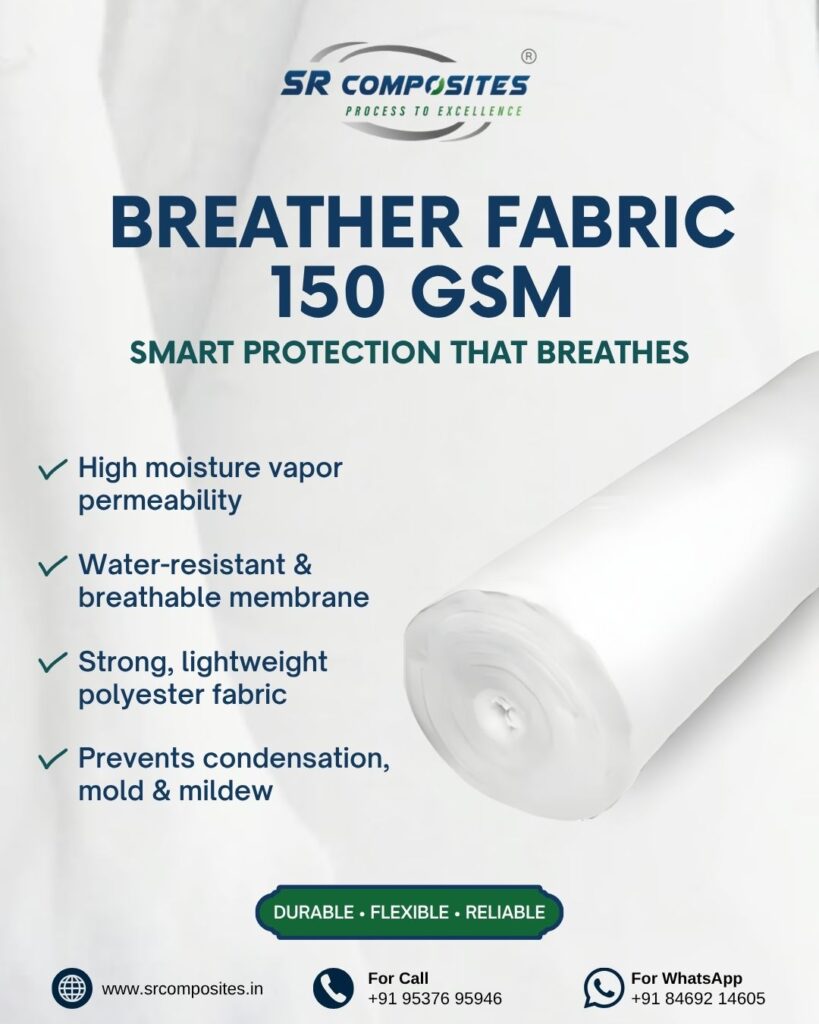
Modern industries require materials that deliver durability, moisture management, and consistent performance under demanding conditions. Breather Fabric 150 GSM has emerged as a reliable solution for manufacturers and engineers who need effective moisture vapor transmission while maintaining protection against water penetration. Its unique construction makes it suitable for a wide range of applications, from composite manufacturing to building insulation systems.
As industries continue to focus on product quality, process efficiency, and long-term durability, the demand for high-performance breathable fabrics has increased significantly. Breather Fabric 150 GSM offers an ideal balance of strength, flexibility, and breathability, helping manufacturers achieve better results while reducing the risk of moisture-related damage.
What is Breather Fabric 150 GSM?
Breather Fabric 150 GSM is a specially engineered polyester-based fabric designed to allow moisture vapor to pass through while preventing the accumulation of condensation and trapped moisture. The fabric is lightweight yet strong enough to withstand demanding industrial environments.
The 150 GSM weight provides excellent structural stability without adding unnecessary bulk. This balance allows the material to perform efficiently in vacuum bagging processes, composite curing applications, roofing systems, insulation assemblies, and various moisture-control environments.
Its breathable membrane structure helps maintain airflow and vapor transmission, reducing the chances of mold, mildew, and condensation-related deterioration. As a result, industries that prioritize durability and product integrity increasingly rely on Breather Fabric 150 GSM as a critical component of their manufacturing processes.
Key Features of Breather Fabric 150 GSM
One of the primary reasons for the growing popularity of Breather Fabric 150 GSM is its combination of performance-enhancing features.
The fabric offers high moisture vapor permeability, allowing water vapor to escape efficiently while maintaining protection against external moisture. This capability helps maintain dry internal environments and improves overall system longevity.
Its water-resistant yet breathable construction protects without restricting airflow. This makes it suitable for applications where moisture control is essential, but ventilation cannot be compromised.
The material is manufactured using high-quality polyester fibers, providing excellent tensile strength and dimensional stability. Even under challenging industrial conditions, Breather Fabric 150 GSM maintains consistent performance.
The lightweight design simplifies handling, installation, and integration into production systems. Manufacturers can improve operational efficiency without sacrificing product quality.
Another important feature is its ability to reduce condensation formation. By allowing moisture vapor to escape, the fabric minimizes conditions that encourage mold and mildew growth, helping preserve equipment, structures, and finished products.
Applications of Breather Fabric 150 GSM Across Industries
The versatility of Breather Fabric 150 GSM allows it to serve multiple industries where moisture management and airflow are critical.
In composite manufacturing, the fabric is commonly used during vacuum bagging operations. It facilitates uniform vacuum distribution and assists in removing excess air and volatiles from the laminate. This contributes to improved composite quality and better surface finishes.
The aerospace sector relies on advanced composite processes that require consistent airflow and pressure management. Breather fabrics help maintain process integrity while supporting the production of lightweight, high-strength components.
In marine applications, moisture control is essential for maintaining structural performance and preventing long-term degradation. Breather Fabric 150 GSM supports manufacturing processes that demand reliability and precision.
The construction industry also benefits from breathable fabrics in roofing systems, wall assemblies, and insulation installations. These materials help regulate moisture movement, improving building durability and indoor environmental quality.
For information on modern building moisture management practices, readers can refer to the official guidelines published by the U.S. Department of Energy: https://www.energy.gov
Benefits of Using Breather Fabric 150 GSM
The use of Breather Fabric 150 GSM offers numerous operational and performance advantages.
One of the most significant benefits is enhanced moisture management. Moisture trapped within systems can lead to material degradation, corrosion, and reduced efficiency. By facilitating vapor transmission, the fabric helps maintain optimal operating conditions.
Manufacturers also benefit from improved product quality. In composite production, proper airflow and vacuum distribution contribute to better laminate consolidation and reduced defect rates.
The material’s durability ensures long-term performance, reducing replacement frequency and maintenance costs. This reliability is particularly valuable in demanding industrial environments where downtime can be costly.
Its lightweight construction improves handling and installation efficiency, allowing operators to work more effectively and reduce labor requirements.
Another major advantage is protection against mold and mildew growth. Moisture accumulation often creates ideal conditions for biological contamination. The breathable design helps maintain dry conditions and supports cleaner operating environments.
Why Material Quality Matters
The effectiveness of Breather Fabric 150 GSM depends heavily on the quality of the raw materials and manufacturing processes used during production.
Inferior fabrics may exhibit inconsistent permeability, reduced durability, and poor structural integrity. These issues can negatively affect manufacturing outcomes and increase operational costs.
High-quality breather fabrics provide consistent airflow characteristics, dependable moisture management, and reliable performance throughout the production cycle. Manufacturers that prioritize quality materials often achieve better product consistency and improved process control.
Industry best practices for composite manufacturing can be explored through the American Composites Manufacturers Association (ACMA) at https://www.acmanet.org. This resource offers valuable insights into composite technologies and performance standards.
Why Choose SR Composites?
When selecting a supplier for Breather Fabric 150 GSM, experience, quality assurance, and technical expertise are critical considerations.
SR Composites is committed to delivering premium composite consumables designed to meet the evolving needs of modern industries. The company focuses on maintaining strict quality standards to ensure consistent product performance.
Customers benefit from reliable product availability, technical support, and industry-specific expertise. Whether supporting aerospace, marine, automotive, wind energy, or general composite manufacturing applications, SR Composites provides solutions designed for efficiency and long-term value.
By choosing SR Composites, manufacturers gain access to high-quality materials that support improved process control, better product quality, and enhanced operational efficiency.
FAQs
What is Breather Fabric 150 GSM used for?
Breather Fabric 150 GSM is primarily used in composite manufacturing, vacuum bagging processes, roofing systems, insulation applications, and moisture management solutions.
How does Breather Fabric 150 GSM prevent condensation?
The fabric allows moisture vapor to pass through while maintaining protection against external moisture, helping reduce condensation buildup.
Is Breather Fabric 150 GSM suitable for vacuum bagging?
Yes. It is widely used in vacuum bagging applications because it helps distribute vacuum pressure and remove trapped air during composite curing.
What industries commonly use Breather Fabric 150 GSM?
Industries such as aerospace, marine, automotive, wind energy, and construction frequently use this material.
Why is moisture vapor permeability important?
High moisture vapor permeability helps prevent moisture accumulation, reducing the risk of mold, mildew, corrosion, and structural degradation.
Conclusion
Breather Fabric 150 GSM plays a vital role in modern industrial applications where moisture management, airflow, and durability are essential. Its ability to provide high moisture vapor permeability, water resistance, lightweight performance, and long-term reliability makes it a preferred choice across multiple industries. From composite manufacturing to construction applications, this advanced material contributes to improved quality, enhanced efficiency, and greater durability. For businesses seeking dependable composite consumables and moisture-control solutions, SR Composites offers trusted products backed by industry expertise and consistent quality standards.