Table of Contents
- Introduction
- Key Features of HDPE Spiral Tubes
- Technical Specifications
- Benefits of Using HDPE Spiral Tubes
- Applications
- Comparison Table
- Frequently Asked Questions
- Conclusion
Introduction
Discover the benefits of HDPE Spiral Tubes designed to maintain shape under vacuum, ensure efficient resin flow, and provide superior strength for composite manufacturing and industrial applications.
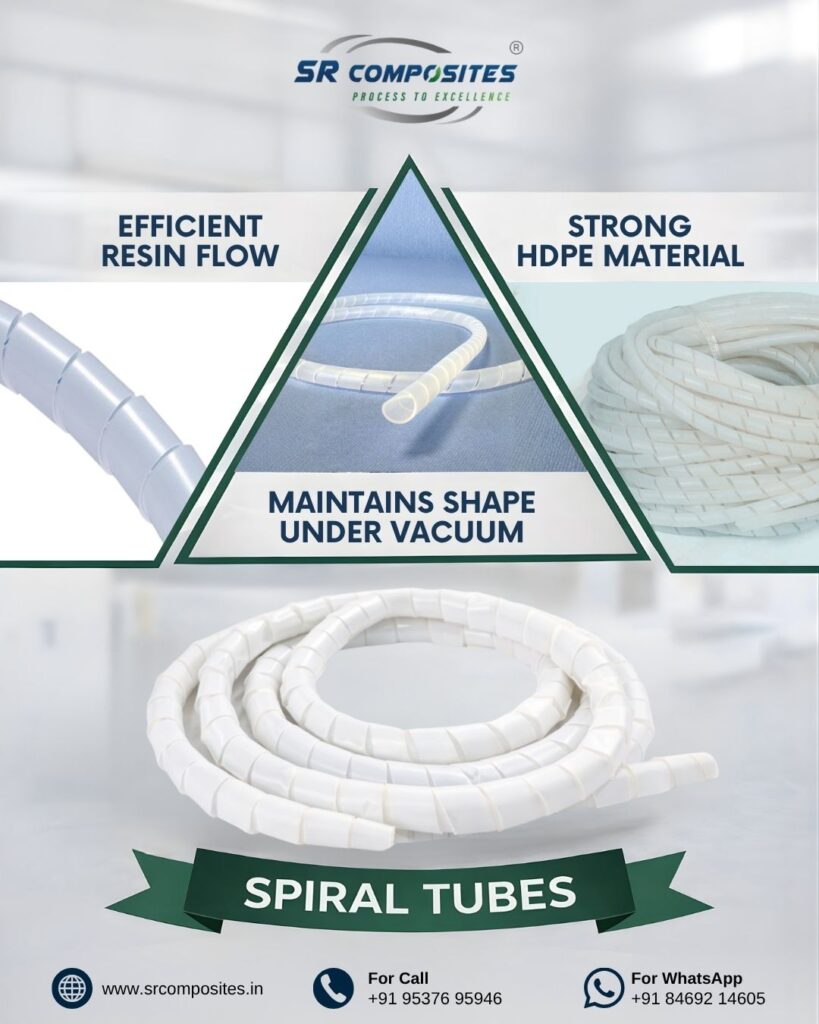
In srcomposite manufacturing and vacuum infusion processes, maintaining consistent resin flow is essential for achieving high-quality results. HDPE Spiral Tubes are specially designed to withstand vacuum pressure while ensuring efficient resin distribution throughout the system. Manufactured from strong HDPE material, these tubes maintain their shape under vacuum conditions and provide reliable performance across various industrial applications.
Their spiral structure enhances resin movement, reduces flow resistance, and helps manufacturers achieve faster and more uniform resin infusion. Due to their durability and flexibility, HDPE Spiral Tubes have become a preferred solution in composite fabrication, marine, automotive, aerospace, and industrial sectors.
Key Features
Maintains Shape Under Vacuum
The spiral design prevents tube collapse even under high vacuum pressure, ensuring uninterrupted resin flow during the infusion process.
Efficient Resin Flow
The open spiral structure allows resin to move quickly and evenly, reducing infusion time and improving manufacturing efficiency.
Strong HDPE Material
Made from High-Density Polyethylene (HDPE), these tubes offer excellent strength, durability, and resistance to wear.
Lightweight Construction
HDPE Spiral Tubes are lightweight, making them easy to handle, install, and transport.
Chemical Resistance
The material offers resistance to various chemicals, resins, and environmental conditions, extending service life.
Flexible and Easy to Use
Their flexibility allows easy placement around complex mold shapes and production setups.
Technical Specifications
| Specification | Details |
|---|---|
| Material | High-Density Polyethylene (HDPE) |
| Structure | Spiral Design |
| Vacuum Resistance | High |
| Resin Flow Efficiency | Excellent |
| Flexibility | High |
| Chemical Resistance | Excellent |
| Weight | Lightweight |
| Industrial Use | Composite Manufacturing |
Benefits of Using HDPE Spiral Tubes
Improved Resin Distribution
Ensures uniform resin flow throughout the laminate structure for better product quality.
Faster Manufacturing Process
Efficient resin transfer reduces infusion time and improves production output.
Reduced Risk of Blockages
The spiral structure minimizes resin accumulation and flow interruptions.
Enhanced Durability
Strong HDPE construction ensures long-lasting performance under demanding conditions.
Cost-Effective Solution
Lower maintenance requirements and improved process efficiency help reduce operational costs.
Applications
Composite Manufacturing
Used extensively in vacuum infusion and resin transfer molding processes.
Marine Industry
Ideal for manufacturing boat hulls, decks, and composite marine components.
Aerospace Components
Supports precision composite fabrication for lightweight aerospace structures.
Automotive Parts Production
Used in composite panels, structural components, and lightweight vehicle parts.
Wind Energy Sector
Suitable for manufacturing wind turbine blades and other large composite structures.
Comparison Table
| Feature | HDPE Spiral Tubes | Standard Tubes |
| Vacuum Resistance | Excellent | Moderate |
| Shape Retention | High | Low |
| Resin Flow Efficiency | Excellent | Average |
| Durability | High | Medium |
| Chemical Resistance | Excellent | Moderate |
| Flexibility | High | Medium |
Frequently Asked Questions
What are HDPE Spiral Tubes used for?
HDPE Spiral Tubes are primarily used in vacuum infusion and composite manufacturing processes for efficient resin distribution.
Why is shape retention under vacuum important?
Shape retention prevents tube collapse, ensuring continuous resin flow and consistent product quality.
Are HDPE Spiral Tubes chemically resistant?
Yes, HDPE material offers excellent resistance to many chemicals, resins, and environmental conditions.
Can these tubes be reused?
Depending on the application and operating conditions, HDPE Spiral Tubes can often be reused multiple times.
Which industries commonly use HDPE Spiral Tubes?
Composite manufacturing, marine, aerospace, automotive, and wind energy industries commonly use these tubes.
Conclusion
HDPE Spiral Tubes are an essential component in modern composite manufacturing processes. Their ability to maintain shape under vacuum, provide efficient resin flow, and deliver long-term durability makes them a reliable choice for industrial applications. With strong HDPE construction, excellent chemical resistance, and superior flow performance, these tubes help manufacturers improve efficiency, product quality, and overall production reliability.
Check this:- https://www.bis.gov.in/