Table of Contents
- Introduction
- What is Breathable Fabric for Composites
- How It Works in Industrial Applications
- Key Features of Breathable Fabric for Composites
- Applications Across Industries
- Benefits of Using Breathable Fabric
- Why Choose SR Composites
- Featured Snippet (Quick Answer)
- FAQ
- Conclusion
Introduction
In modern industrial engineering, material performance is no longer limited to strength alone. Industries now demand materials that are lightweight, durable, and capable of maintaining structural efficiency under extreme conditions. One such innovation is Breathable Fabric for Composites, widely used in advanced manufacturing systems.
Companies like SR Composites are increasingly focusing on high-performance composite materials that integrate breathable fabric layers to improve efficiency, airflow management, and long-term durability in industrial applications.
What is Breathable Fabric for Composites?
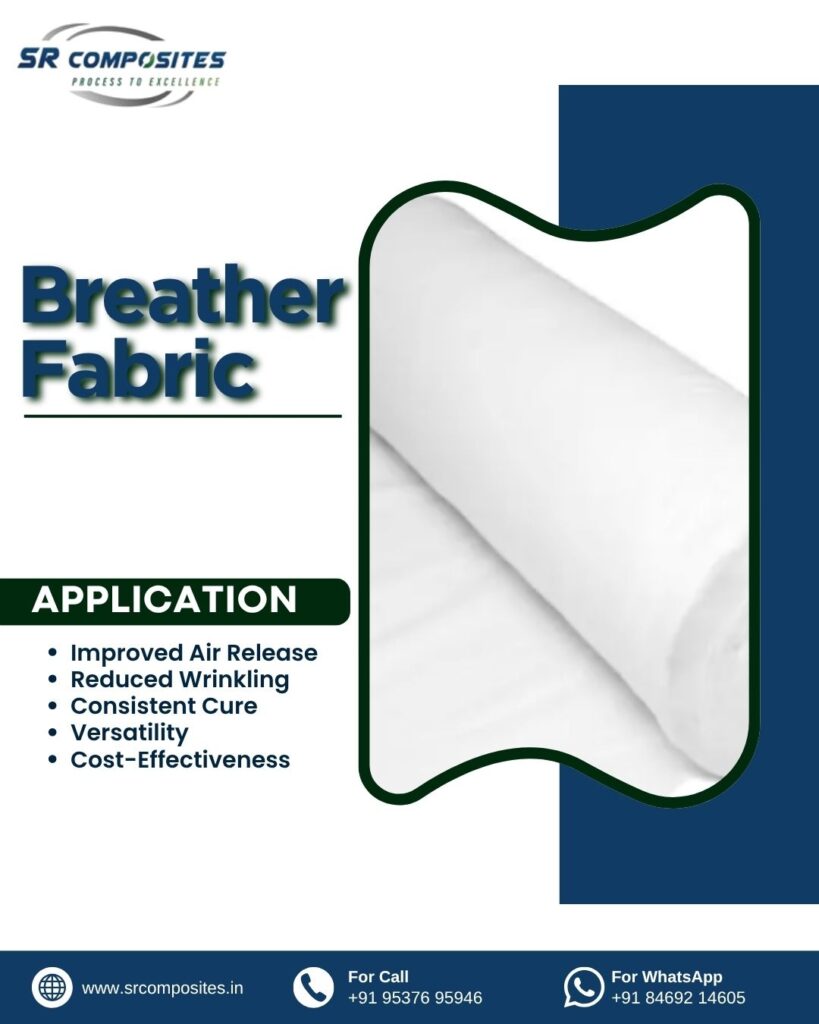
This is a specially engineered textile layer used within composite structures to allow controlled air and moisture flow while maintaining structural integrity.
It is commonly used in:
- Fiber-reinforced composites
- Industrial laminates
- Thermal insulation systems
- Structural panels
The primary role of this fabric is to prevent trapped air, reduce defects during manufacturing, and improve bonding between layers.
How It Works in Industrial Applications
Breathable fabrics function as a controlled ventilation layer during composite manufacturing. When resin is applied, the fabric allows:
- Air to escape from the laminate layers
- Even distribution of resin
- Reduced void formation
- Improved surface finish
This ensures the final composite structure is stronger, more stable, and less prone to internal stress failures.
Key Features of Breathable Fabric for Composites
used in composites offer several advanced engineering properties:
1. High Air Permeability
Allows controlled airflow without compromising structural strength.
2. Thermal Stability
Maintains performance under high-temperature industrial processes.
3. Chemical Resistance
Compatible with resins, adhesives, and industrial coatings.
4. Lightweight Structure
Reduces overall material weight in composite systems.
5. Uniform Resin Flow
Ensures better bonding and reduced defects.
Applications Across Industries
Fabric for Composites is used in multiple sectors:
- Automotive components
- Aerospace structures
- Marine engineering
- Wind energy blades
- Industrial insulation panels
Each application benefits from improved durability and structural efficiency.
Benefits of Using Breathable Fabric for Composites
The use of breathable fabric significantly improves composite performance in industrial environments.
Improved Structural Integrity
By eliminating air pockets, the material becomes more uniform and reliable.
Enhanced Manufacturing Efficiency
Reduces production errors and material waste.
Long-Term Durability
Composites last longer under mechanical and thermal stress.
Better Surface Finish
Ensures smoother final product appearance.
Cost Efficiency
Reduces repair and maintenance costs over time.
Why Choose SR Composites
Industries prefer SR Composites due to its focus on advanced composite engineering solutions and quality-controlled manufacturing processes.
Key reasons include:
- Consistent material quality standards
- Industry-specific customization
- Advanced composite technology integration
- Strong focus on industrial applications
The company’s approach ensures that breathable fabric solutions meet modern engineering demands efficiently. Fabrics used in composites are widely studied in advanced material engineering, with international standards and testing guidelines published by organizations such as ISO (https://www.iso.org) and material research bodies like NIST (https://www.nist.gov).
Featured Snippet (Quick Answer)
What is Breathable Fabric for Composites?
Fabric for Composites is a specialized textile layer used in composite manufacturing that allows air and moisture to pass through while improving resin flow, reducing voids, and increasing structural strength in industrial materials.
FAQ
1. What is the main purpose of breathable fabric in composites?
Breathable fabric helps remove trapped air and ensures uniform resin distribution during composite manufacturing, improving overall strength and durability.
2. Where is breathable fabric for composites commonly used?
It is widely used in automotive, aerospace, marine, wind energy, and industrial insulation applications due to its performance benefits.
3. Does breathable fabric affect the strength of composites?
Yes, positively. It enhances structural integrity by reducing voids and improving bonding between composite layers.
4. Why is it important in industrial manufacturing?
It improves production efficiency, reduces defects, and ensures high-quality output in composite-based systems.
5. How does SR Composites contribute to this technology?
The company focuses on delivering advanced composite materials that integrate breathable fabric technology for improved industrial performance.
Conclusion
Fabric for Composites has become a critical component in modern industrial manufacturing. Its ability to improve airflow, reduce defects, and enhance structural performance makes it essential across multiple high-performance sectors.
With companies like SR Composites advancing material engineering, industries are moving toward more efficient, durable, and cost-effective composite solutions.