Table of Contents
- Introduction
- What is Breather Fabric?
- Why Breather Fabric is Important in Composite Manufacturing
- Breather Fabric at a Glance
- Key Features of Breather Fabric
- Applications of Breather Fabric
- Benefits of Using Breather Fabric
- FAQs
- Conclusion
Introduction
Discover high-quality Breather Fabric from SR Composites for vacuum bagging and SR composite manufacturing. Improve air release, reduce wrinkling, achieve consistent curing, and enhance laminate quality with cost-effective composite solutions.
In composite manufacturing, achieving high-quality laminates requires precise control over air evacuation, resin flow, and curing conditions. One of the most important materials used during the vacuum bagging process is Breather Fabric. It plays a crucial role in ensuring consistent pressure distribution and effective air removal throughout the laminate
SR Composites offers premium-quality Breather Fabric designed to improve air release, reduce wrinkling, ensure consistent curing, and enhance overall manufacturing efficiency. Whether used in aerospace, marine, automotive, or industrial composite applications, Breather Fabric contributes significantly to producing strong and defect-free composite components.
Check this: – https://www.indiamart.com/
What is Breather Fabric?
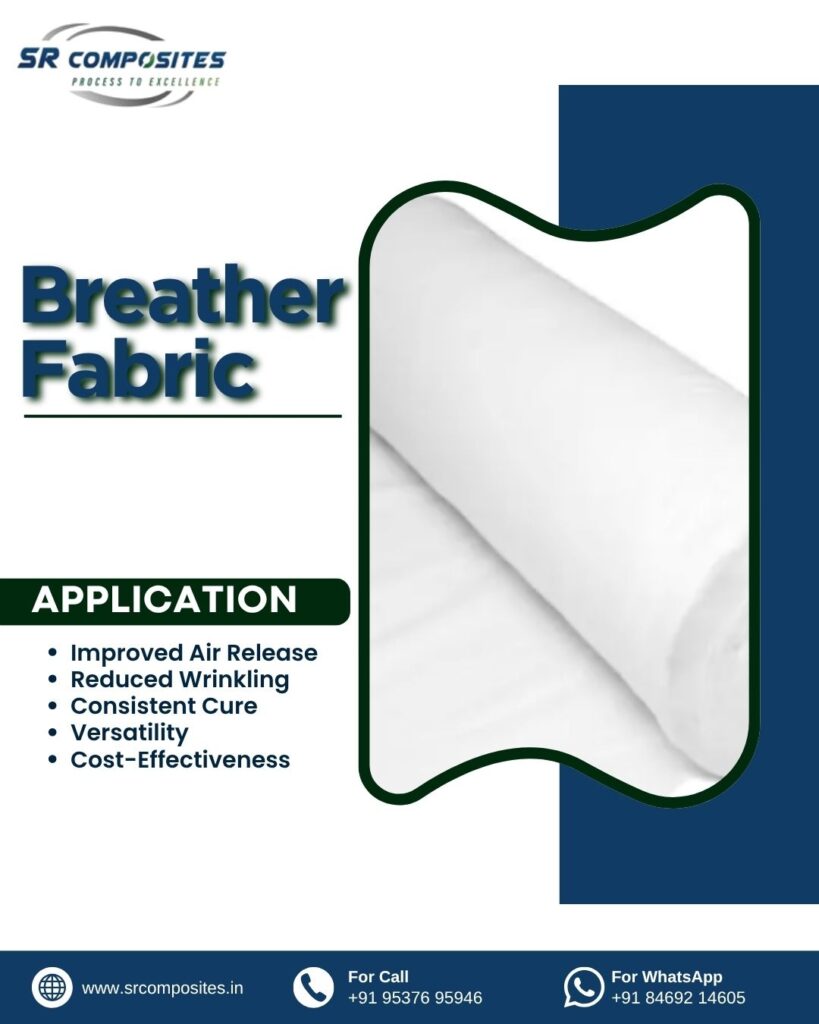
Breather Fabric is a non-woven polyester material used in vacuum bagging processes. It allows air and gases to move freely beneath the vacuum bag while maintaining even pressure across the laminate surface.
The material acts as an air passage, enabling trapped air and volatile gases to escape during curing. This helps manufacturers achieve superior laminate quality and minimize defects caused by air entrapment.
Why Breather Fabric is Important in Composite Manufacturing
During vacuum bagging, trapped air can create voids, weak spots, and surface imperfections within composite structures. Breather Fabric provides a pathway for air evacuation and helps maintain uniform vacuum pressure throughout the curing cycle.
By improving airflow and pressure distribution, Breather Fabric ensures stronger laminates, better surface finish, and improved structural integrity.
Breather Fabric at a Glance
| Feature | Description |
|---|---|
| Product Name | Breather Fabric |
| Brand | SR Composites |
| Material Type | Non-Woven Polyester Fabric |
| Primary Function | Air Evacuation During Vacuum Bagging |
| Application | Composite Manufacturing & Vacuum Infusion |
| Key Advantage | Improved Air Release |
| Curing Performance | Consistent and Uniform Cure |
| Wrinkle Prevention | Reduces Surface Wrinkling |
| Reusability | Depending on Application |
| Industries Served | Aerospace, Marine, Automotive, Industrial |
Key Features of Breather Fabric
| Feature | Benefit |
|---|---|
| Improved Air Release | Helps remove trapped air and gases efficiently |
| Reduced Wrinkling | Minimizes laminate distortion during curing |
| Consistent Cure | Maintains uniform pressure across the laminate |
| High Versatility | Suitable for multiple composite manufacturing processes |
| Cost-Effective Solution | Reduces defects and rework costs |
| Excellent Airflow | Supports efficient vacuum bagging operations |
| Lightweight Design | Easy to handle and apply |
Improved Air Release
Breather Fabric provides efficient pathways for air evacuation, reducing voids and improving laminate quality.
Reduced Wrinkling
The fabric helps maintain smooth pressure distribution, preventing wrinkles and surface irregularities.
Consistent Cure
Uniform airflow and pressure contribute to consistent resin curing throughout the composite structure.
Versatility
Suitable for vacuum bagging, resin infusion, prepreg processing, and various composite manufacturing techniques.
Cost-Effectiveness
By minimizing defects and reducing material waste, Breather Fabric helps lower overall production costs.
Applications of Breather Fabric
Aerospace Industry
Used in aircraft composite structures where high-quality laminates are essential.
Marine Manufacturing
Supports the production of boats, yachts, and marine composite components.
Automotive Components
Ensures reliable curing and high-strength composite parts.
Wind Energy Sector
Used in manufacturing wind turbine blades and structural composite components.
Industrial Fabrication
Ideal for tanks, panels, ducts, and custom composite products.
Sports & Recreation Equipment
Used in advanced composite sporting goods and performance equipment.
Benefits of Using Breather Fabric
| Benefit | Manufacturing Impact |
|---|---|
| Better Air Evacuation | Reduces void formation |
| Improved Laminate Quality | Produces stronger composite parts |
| Uniform Pressure Distribution | Ensures consistent curing |
| Lower Defect Rate | Minimizes rework and scrap |
| Enhanced Productivity | Improves manufacturing efficiency |
| Cost Savings | Reduces material wastage |
| Better Surface Finish | Improves final product appearance |
Frequently Asked Questions (FAQs)
1. What is the purpose of Breather Fabric?
Breather Fabric allows air and gases to escape during vacuum bagging, ensuring proper laminate consolidation and curing.
2. Can Breather Fabric be used in vacuum infusion processes?
Yes. It is commonly used in vacuum infusion, vacuum bagging, and prepreg composite manufacturing.
3. How does Breather Fabric improve composite quality?
It helps remove trapped air, maintain uniform pressure, and achieve a consistent cure throughout the laminate.
4. Which industries commonly use Breather Fabric?
Aerospace, marine, automotive, wind energy, and industrial manufacturing sectors frequently use Breather Fabric.
5. Is Breather Fabric a cost-effective solution?
Yes. It reduces defects, minimizes material waste, and lowers overall production costs.
Conclusion
Breather Fabric is an essential component in modern composite manufacturing and vacuum bagging processes. Its ability to improve air release, reduce wrinkling, maintain consistent curing conditions, and enhance laminate quality makes it a valuable material for producing high-performance composite parts.
SR Composites’ Breather Fabric is engineered to deliver reliable performance across a wide range of applications, helping manufacturers achieve stronger laminates, improved productivity, and superior product quality. Whether for aerospace, marine, automotive, or industrial applications, Breather Fabric remains a critical element in successful composite fabrication.