Table of Contents
- Introduction
- What is an Omega Profile?
- How Omega Profiles Work in Vacuum Infusion
- Key Features of Omega Profiles
- Benefits of Using Omega Profiles
- Applications of Omega Profiles
- Omega Profile Technical Overview
- Why Composite Manufacturers Choose Omega Profiles
- Omega Profile vs Traditional Resin Flow Methods
- Best Practices for Installation
- Frequently Asked Questions
- Conclusion
Introduction
SR Composite manufacturing has transformed industries such as aerospace, automotive, marine, renewable energy, and industrial engineering. One of the most important processes in composite fabrication is vacuum infusion, where resin is distributed evenly throughout reinforcement materials to create strong and lightweight composite structures.
Achieving uniform resin flow can be challenging, especially in large or complex components. This is where Omega Profiles become an essential solution. Designed specifically for vacuum infusion applications, Omega Profiles improve resin distribution, prevent dry spots, reduce resin pooling, and enhance overall manufacturing efficiency.
By optimizing resin flow paths, Omega Profiles help manufacturers produce high-quality composite parts with improved consistency and reduced material waste.
What is an Omega Profile?
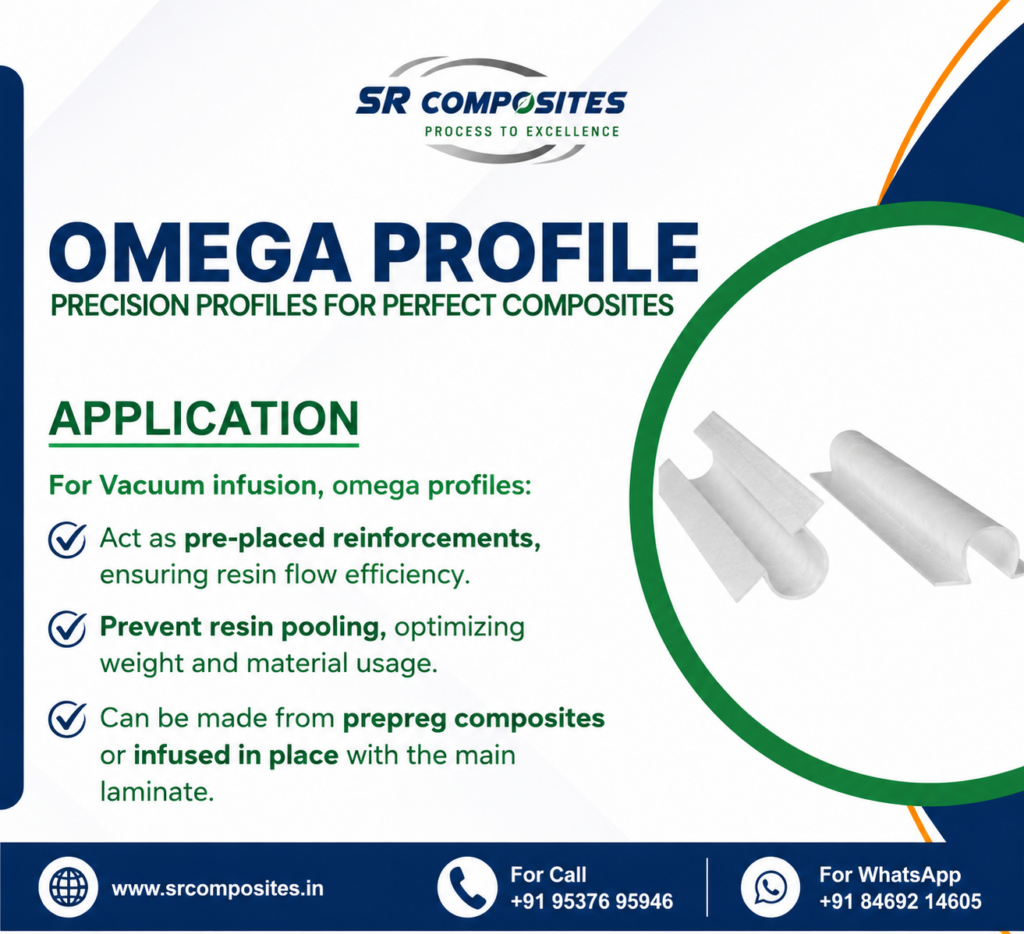
An Omega Profile is a specially designed composite reinforcement profile used in vacuum infusion systems. Its unique shape creates dedicated resin channels that allow resin to flow efficiently across the laminate during the infusion process.
Omega Profiles are commonly placed on the laminate surface before vacuum bagging and serve as controlled pathways that distribute resin quickly and evenly throughout the composite structure.
These profiles are widely used in industries where precision, strength, and manufacturing efficiency are critical.
How Omega Profiles Work in Vacuum Infusion
During vacuum infusion, resin is drawn into a mold through vacuum pressure. Without proper flow channels, resin may distribute unevenly, leading to defects and inconsistent part quality.
Omega Profiles solves this challenge by:
- Creating controlled resin flow channels.
- Accelerating resin distribution across the laminate.
- Reducing infusion time.
- Ensuring complete wet-out of reinforcement materials.
- Minimizing dry spots and void formation.
The result is a stronger and more reliable composite component.
Key Features of Omega Profiles
Pre-Placed Reinforcement Design
Omega Profiles act as integrated reinforcement channels that improve resin movement throughout the laminate.
Efficient Resin Flow
The profile geometry allows smooth and controlled resin distribution during vacuum infusion.
Reduced Resin Pooling
The structured design prevents excess resin accumulation in localized areas.
Lightweight Construction
Omega Profiles contribute to weight optimization by reducing unnecessary resin usage.
Compatibility with Composite Systems
Suitable for prepreg composites, vacuum infusion systems, and advanced composite manufacturing processes.
Customizable Dimensions
Available in various sizes and specifications to meet different manufacturing requirements.
Benefits of Using Omega Profiles
Improved Resin Distribution
Ensures consistent resin flow throughout the laminate for superior part quality.
Faster Manufacturing Cycles
Accelerates resin infusion and reduces production time.
Enhanced Structural Integrity
Uniform resin distribution improves mechanical performance and durability.
Lower Material Waste
Minimizes resin wastage by optimizing resin flow paths.
Better Surface Finish
Reduces defects, dry spots, and air entrapment during manufacturing.
Cost Savings
Increased efficiency and reduced material consumption lower overall production costs.
Applications of Omega Profiles
| Industry | Application |
|---|---|
| Aerospace | Aircraft composite components |
| Automotive | Lightweight vehicle structures |
| Marine | Boat hulls and deck panels |
| Wind Energy | Wind turbine blades |
| Construction | Composite structural elements |
| Industrial Equipment | High-performance composite parts |
| Transportation | Railway and transit components |
Omega Profile Technical Overview
| Feature | Description |
|---|---|
| Product Type | Resin Flow Profile |
| Manufacturing Process | Vacuum Infusion |
| Function | Resin Distribution |
| Material Compatibility | Composite Laminates |
| Installation | Pre-placed on laminate |
| Benefits | Faster infusion and reduced resin pooling |
Why Composite Manufacturers Choose Omega Profiles
Manufacturers increasingly rely on Omega Profiles because they provide a practical solution to common infusion challenges.
Key reasons include:
- Consistent product quality.
- Faster resin infusion.
- Reduced manufacturing defects.
- Improved process reliability.
- Lower operational costs.
- Enhanced composite performance.
These advantages make Omega Profiles an essential component in modern composite manufacturing facilities.
Omega Profile vs Traditional Resin Flow Methods
| Feature | Omega Profile | Traditional Methods |
|---|---|---|
| Resin Flow Efficiency | High | Moderate |
| Infusion Speed | Faster | Slower |
| Resin Pooling | Minimal | Higher Risk |
| Material Waste | Lower | Higher |
| Quality Consistency | Excellent | Variable |
| Manufacturing Efficiency | High | Medium |
Best Practices for Installation
Proper Placement
Position Omega Profiles strategically along resin flow paths.
Maintain Vacuum Integrity
Ensure vacuum bagging is properly sealed before infusion begins.
Optimize Resin Entry Points
Design resin feed locations to maximize flow efficiency.
Monitor Resin Flow
Observe infusion progress to ensure complete laminate wet-out.
Follow Manufacturer Guidelines
Use recommended installation procedures for optimal results.
Frequently Asked Questions
What is the primary purpose of an Omega Profile?
Omega Profiles create efficient resin flow channels during vacuum infusion processes.
Can Omega Profiles reduce resin consumption?
Yes. They help distribute resin efficiently and reduce unnecessary resin accumulation.
Which industries use Omega Profiles?
Aerospace, automotive, marine, wind energy, transportation, and industrial manufacturing sectors commonly use them.
Are Omega Profiles suitable for large composite structures?
Yes. They are particularly effective in large and complex composite components.
Can Omega Profiles be used with prepreg materials?
Yes. Omega Profiles can be manufactured from prepreg composites or infused directly with the laminate.
Do Omega Profiles improve product quality?
Absolutely. They help eliminate dry spots, improve wet-out, and create more consistent composite structures.
Conclusion
Omega Profiles play a vital role in modern vacuum infusion and composite manufacturing processes. By improving resin flow, preventing resin pooling, reducing manufacturing defects, and increasing production efficiency, they help manufacturers achieve superior composite part quality.
Whether used in aerospace, automotive, marine, or industrial applications, Omega Profiles provide a reliable and cost-effective solution for achieving high-performance composite structures. As composite technology continues to evolve, Omega Profiles remain an important component for optimizing manufacturing processes and delivering consistent, high-quality results.
Check this:- https://msme.gov.in/