Table of Contents
- Introduction
- What is a T Connector?
- Key Features
- Benefits
- Applications
- Technical Specifications
- Working Principle
- Why Use This Vacuum Fitting?
- Installation and Maintenance Tips
- About SR Composites
- Frequently Asked Questions
- Conclusion
Introduction
A T Connector is an essential component used in vacuum bagging, resin infusion, and SR composite manufacturing processes. Designed to split or combine vacuum lines efficiently, it helps maintain smooth airflow distribution throughout the system. These connectors play a vital role in ensuring consistent vacuum pressure, improving process reliability, and enhancing overall production efficiency.
Widely used in FRP fabrication, aerospace manufacturing, marine applications, and industrial composite production, this fitting provides a practical solution for managing multiple vacuum lines without compromising system performance.
What is a T Connector?
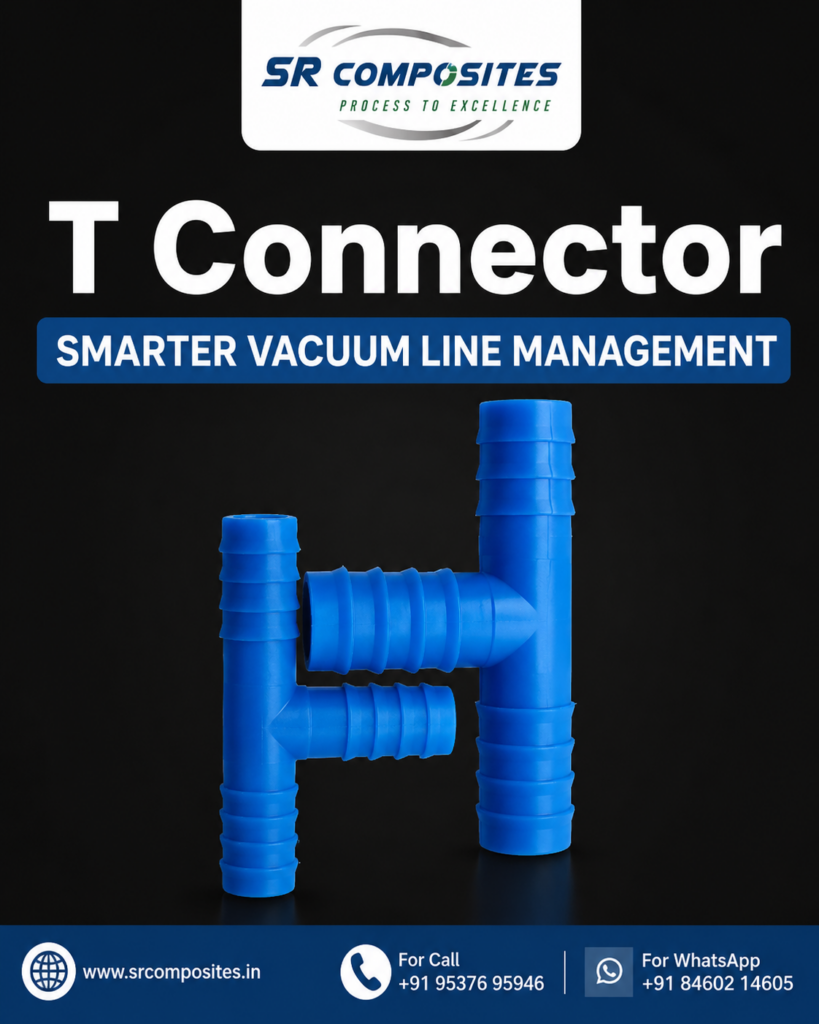
A T Connector is a specially designed fitting that joins three tubing connections in a T-shaped configuration. It allows vacuum flow to be distributed between multiple channels or collected into a single pathway.
These fittings are commonly integrated into vacuum bagging systems to improve airflow control and simplify tubing layouts during manufacturing operations.
Key Features
Strong and Durable Construction
Manufactured from high-quality materials for long-term industrial use.
Efficient Airflow Distribution
Helps maintain balanced vacuum flow throughout the system.
Easy Hose Integration
Compatible with various vacuum tubing sizes.
Leak-Resistant Design
Supports reliable vacuum performance during operation.
Lightweight Structure
Easy to install, transport, and replace.
Reusable Performance
Can be used repeatedly with proper maintenance.
Benefits
Improves Vacuum Management
Allows better organization of multiple vacuum lines.
Enhances Process Efficiency
Supports uninterrupted manufacturing operations.
Reduces System Complexity
Simplifies tubing arrangements in production setups.
Reliable Performance
Maintains consistent vacuum pressure distribution.
Cost-Effective Solution
Provides long service life with minimal maintenance requirements.
Flexible Installation
Suitable for different composite manufacturing configurations.
Applications
Resin Infusion Processes
Used to manage vacuum flow during resin transfer operations.
Vacuum Bagging Systems
Helps distribute vacuum pressure across multiple sections.
FRP Manufacturing
Supports fiberglass and composite fabrication projects.
Marine Industry
Applied in boat and yacht composite production.
Aerospace Components
Used in advanced composite manufacturing systems.
Industrial Production Facilities
Suitable for vacuum-based processing applications.
Technical Specifications
| Property | Description |
|---|---|
| Product Type | T Connector |
| Configuration | Three-Way Connection |
| Application | Vacuum Line Distribution |
| Compatibility | Vacuum Tubing Systems |
| Usage | Composite Manufacturing |
| Installation | Easy Push-Fit Connection |
| Reusability | Yes |
| Industry Use | FRP, Aerospace, Marine, Industrial |
Working Principle
Vacuum Line Connection
The fitting connects multiple vacuum hoses into a single network.
Airflow Distribution
Vacuum pressure is evenly distributed through connected channels.
Pressure Management
Supports stable vacuum performance during manufacturing.
Efficient Process Control
Helps improve consistency throughout production cycles.
Why Use This Vacuum Fitting?
Better Workflow Organization
Keeps tubing layouts clean and manageable.
Consistent Vacuum Performance
Supports reliable process outcomes.
Easy System Expansion
Allows additional vacuum lines to be integrated when required.
Reduced Downtime
Quick installation and replacement save valuable production time.
Suitable for Multiple Industries
Can be used across various vacuum-based manufacturing applications.
Installation and Maintenance Tips
Verify Hose Compatibility
Ensure tubing dimensions match connector specifications.
Check for Secure Connections
Prevent vacuum leaks by properly fitting hoses.
Inspect Regularly
Monitor fittings for wear and damage.
Clean Before Reuse
Remove dust, resin, or debris before installation.
Store Properly
Keep in a dry and contamination-free environment.
About SR Composites
SR Composites is a trusted manufacturer and supplier of composite processing materials, vacuum bagging accessories, resin infusion products, industrial consumables, and FRP manufacturing solutions. With a focus on quality, innovation, and performance, the company provides dependable products that support efficient production processes across aerospace, marine, automotive, wind energy, and industrial sectors. Guided by its commitment to “Process to Excellence,” SR Composites continues to deliver reliable solutions designed to improve manufacturing efficiency and product quality.
Frequently Asked Questions (FAQs)
What is a T Connector used for?
It is used to distribute or combine vacuum lines within vacuum bagging and composite manufacturing systems.
Can this fitting be reused?
Yes, it can be reused multiple times when maintained properly.
Is it suitable for resin infusion applications?
Yes, it is commonly used in resin infusion and vacuum-assisted manufacturing processes.
Does it help improve vacuum distribution?
Yes, it helps ensure efficient and balanced vacuum flow.
Can it be used in FRP production?
Absolutely, it is widely used in fiberglass and composite fabrication.
Is installation complicated?
No, most systems allow quick and straightforward installation.
Which industries use these fittings?
Aerospace, marine, automotive, wind energy, and industrial manufacturing sectors frequently use them.
Conclusion
A T Connector is a simple yet highly effective component for managing vacuum lines in composite manufacturing and vacuum bagging systems. Its ability to distribute airflow efficiently, simplify tubing arrangements, and support consistent vacuum performance makes it an important accessory in modern production environments.
Check this:-https://www.indiamart.com/
Whether used in resin infusion, FRP fabrication, aerospace manufacturing, or industrial applications, this fitting contributes to improved workflow efficiency, reduced complexity, and reliable process performance.