📌 Quick Summary
Nylon peel ply is a woven composite release fabric used during curing to create a clean, textured surface for secondary bonding. It improves adhesion strength, reduces finishing work, and ensures consistent surface quality in aerospace, automotive, marine, and wind energy manufacturing.
📌 Introduction
In composite manufacturing, surface preparation often decides whether a component performs well or fails prematurely. Many engineers focus on resin systems and reinforcement fibers, but the real challenge usually lies in achieving a clean, bond-ready surface after curing.
This is where nylon peel ply becomes highly important. It is widely used in industrial production lines to eliminate contamination, reduce manual sanding, and improve bonding consistency between composite layers.
In practical manufacturing environments, even minor surface contamination—dust, oil, or uneven resin exposure—can significantly reduce adhesion strength. Nylon peel ply helps solve this problem in a controlled and repeatable way.
📌 What is Nylon Peel Ply?
It is a specially engineered woven fabric placed on top of wet composite laminates during the curing process. Once curing is complete, the fabric is removed, leaving behind a uniform, slightly textured surface.
This surface is ideal for secondary bonding, painting, or coating without additional sanding.
In simple terms, nylon peel ply acts as a temporary finishing layer that improves long-term structural reliability.
Key characteristics:
- High temperature resistance during curing
- Clean removal without residue
- Creates controlled surface roughness
- Compatible with epoxy and resin systems
📌 Why Nylon Peel Ply is Important
The importance of nylon peel ply comes from its direct impact on manufacturing efficiency and product reliability.
In traditional composite workflows, surface preparation requires sanding, cleaning, and inspection. These steps are time-consuming and often inconsistent due to human variation.
By using nylon peel ply, manufacturers achieve:
- More consistent bonding surfaces across batches
- Reduced labor cost and finishing time
- Lower risk of contamination during production
- Improved adhesive performance between composite layers
In real industrial applications, this leads to fewer rejections and more predictable output quality.
📌 How Nylon Peel Ply Works
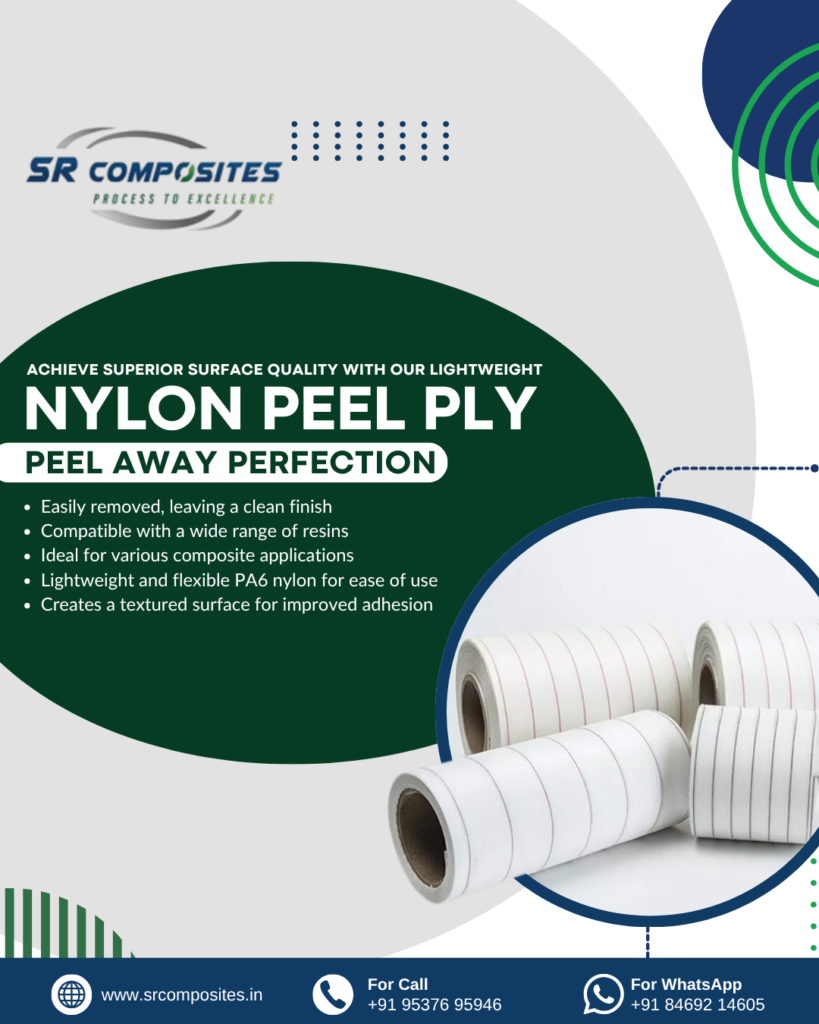
The working process of this is straightforward but highly effective in production environments.
First, composite fibers are placed in a mold, and resin is applied. A layer of nylon peel ply is then placed over the wet surface. During vacuum bagging and curing, heat and pressure consolidate the laminate.
Once the curing process is complete, the peel ply is removed manually. What remains is a clean, textured surface that is immediately ready for bonding or coating.
This eliminates the need for post-curing sanding and ensures repeatable surface quality across production batches.
📌 Industrial Applications of Nylon Peel Ply
Nylon peel ply is widely used in industries where composite performance and structural reliability are critical.
In aerospace manufacturing, it is used for structural panels and interior components where safety and precision are essential. In automotive applications, it supports lightweight structural parts and performance components. Marine industries rely on it for hull and deck fabrication, where strength and corrosion resistance are important.
Wind energy manufacturers also use peel ply extensively in turbine blade production, where large composite surfaces must maintain consistent bonding quality.
📌 Nylon Peel Ply vs Polyester Peel Ply
Both nylon and polyester peel ply are used in composite manufacturing, but their performance differs depending on application requirements.
Nylon peel ply offers higher temperature resistance and better surface finish consistency, making it suitable for aerospace and high-performance engineering. Polyester peel ply is more cost-effective and is generally used in less demanding applications.
Simple comparison:
| Feature | Nylon Peel Ply | Polyester Peel Ply |
|---|---|---|
| Heat resistance | High | Moderate |
| Surface quality | Excellent | Good |
| Cost | Higher | Lower |
| Industrial use | High-performance | General use |
📌 Common Mistakes in Usage
Even though nylon peel ply is easy to use, incorrect handling can reduce its effectiveness.
One common mistake is reusing peel ply, which leads to inconsistent surface quality. Another issue is improper storage in humid conditions, which can degrade material performance.
Some manufacturers also fail to match peel ply with the correct resin system, resulting in bonding inconsistencies.
Avoiding these mistakes ensures stable production output and better material performance.
🇮🇳 Government of India – Ministry of Textiles (Technical Textiles Mission)
👉 https://texmin.gov.in/
📌 Why Choose SR Composites
Choosing the right supplier is critical in composite manufacturing because material consistency directly affects final product quality.
SR Composites provides industrial-grade composite materials designed for real production environments. Their focus is on maintaining consistent weave quality, reliable supply chains, and technical support for manufacturers.
This makes them suitable for OEM-level production where repeatability and quality control are essential.
📌 FAQs
What is nylon peel ply used for?
It is used to create a clean and textured surface on composite parts after curing for better bonding.
Can nylon peel ply be reused?
No, it is designed for single-use to maintain quality consistency.
Why is nylon peel ply important in composites?
It improves bonding strength and removes the need for sanding.
Where is nylon peel ply commonly used?
It is used in aerospace, automotive, marine, and wind energy industries.
Is nylon peel ply better than polyester?
Yes, for high-performance applications due to better heat resistance and surface quality.
📌 Conclusion
Nylon peel ply plays a vital role in modern composite manufacturing by ensuring clean, consistent, and bond-ready surfaces. It improves production efficiency, reduces manual errors, and enhances structural performance across multiple industries.
For manufacturers looking to improve quality and consistency in composite production, SR Composites offers reliable industrial-grade solutions.