Vacuum Bagging Film: The Key to Stronger and More Reliable Composite Parts
Modern industries are constantly searching for materials that offer exceptional strength while keeping weight to a minimum. Vacuum Bagging Film. From aircraft and wind turbines to racing vehicles and marine structures, composite materials have become the preferred choice for engineers who need high performance without sacrificing durability.
However, producing a high-quality composite component is not simply about choosing the right fiber reinforcement or resin system. The manufacturing process itself plays an equally important role. Even the best materials can produce disappointing results if air becomes trapped inside the laminate or if pressure is not distributed evenly during curing.
This is where Vacuum Bagging Film becomes essential. Although it may appear to be a simple consumable material, it is one of the most important elements in composite production. Creating an airtight environment around a laminate, it helps manufacturers achieve better consolidation, fewer defects, and more consistent results.
For decades, manufacturers around the world have relied on this process to produce lightweight structures capable of performing in some of the most demanding environments. Whether the application involves aerospace components, marine products, sporting equipment, or industrial tooling, proper vacuum bagging often determines the difference between average quality and exceptional performance.
Table of Contents
- What Is Vacuum Bagging Film?
- Why It Matters in Composite Manufacturing
- Key Features
- How the Process Works
- Major Benefits
- Real-World Example
- Industry Applications
- Selection Guide
- Best Practices
- Frequently Asked Questions
- Conclusion
What Is Vacuum Bagging Film?
Vacuum Bagging Film is a flexible barrier material used to seal composite laminates during manufacturing. Once the reinforcement materials have been placed on a mold, the film covers the entire layup and creates a closed environment.
Air is then removed using a vacuum pump, generating pressure across the laminate surface. This pressure compresses the layers, improves contact between fibers and resin, and minimizes the risk of trapped air.
The process is widely used in advanced composites because it improves structural consistency while helping manufacturers achieve precise engineering requirements. Without an effective vacuum enclosure, it becomes difficult to produce components with the strength, reliability, and surface quality expected in modern industries.
Why Vacuum Bagging Is Important
Many manufacturing defects begin with something that cannot easily be seen: air trapped inside the laminate. These tiny voids may seem insignificant, but they can reduce mechanical performance and create weak points within the structure.
Consider a carbon-fiber panel designed for a racing vehicle. Even a small amount of trapped air can affect stiffness and long-term durability. Over time, repeated loading and vibration may cause these hidden imperfections to grow into larger problems.
Vacuum processing helps eliminate this risk by applying uniform pressure across the entire component. As the laminate cures, the layers are compacted together, creating a denser and stronger structure.
This controlled environment allows manufacturers to produce parts that are lighter, stronger, and more reliable while maintaining consistent quality from one production cycle to the next.
Key Features of Vacuum Bagging Materials
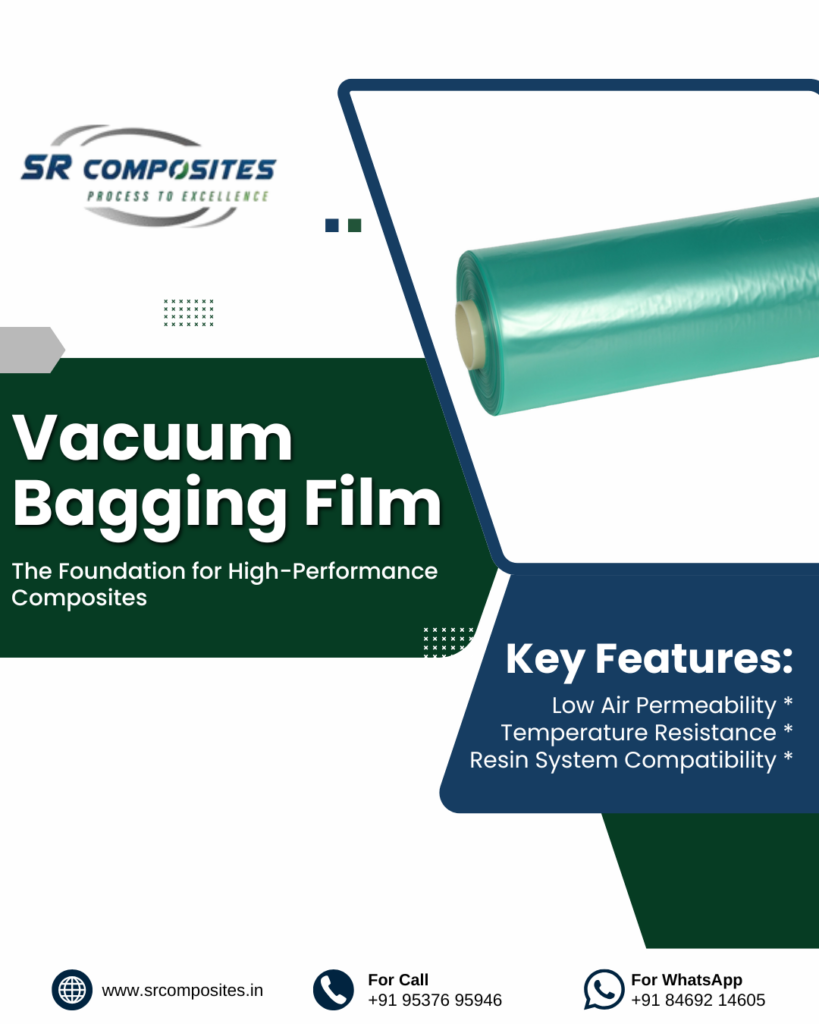
Excellent Air Retention
One of the most important characteristics of any bagging system is its ability to maintain vacuum pressure throughout the curing cycle. Vacuum Bagging Film: Stable pressure contributes directly to improved laminate quality and reduced defects.
High Temperature Performance
Many composite processes require elevated curing temperatures. Modern bagging materials are engineered to withstand these conditions without losing their structural integrity.
Outstanding Flexibility
Complex molds often include deep contours and challenging shapes. Flexible films conform to these geometries while maintaining an effective seal.
Strong Tear Resistance
Durability is critical during installation and processing. A high-quality film resists punctures and tears that could compromise vacuum performance.
Resin Compatibility
Composite manufacturers use a variety of resin systems. Reliable bagging materials remain stable when exposed to epoxy, polyester, and vinyl ester formulations.
How the Process Works
The vacuum bagging process begins with preparing the mold and positioning the reinforcement materials. Once the laminate stack is complete, supporting consumables such as peel ply, release films, and breather fabrics are added.
The bagging membrane is then carefully placed over the assembly and sealed around the mold perimeter using specialized sealant tape.
A vacuum pump removes air from inside the enclosure, causing atmospheric pressure to compress the laminate. This pressure remains active throughout the curing cycle.
As the resin hardens, the laminate becomes fully consolidated. The result is a finished component with improved structural integrity, fewer voids, and a more uniform appearance.
The Benefits of Vacuum Bagging Film
Improved Structural Strength
Removing trapped air and enhancing fiber consolidation creates stronger composite structures capable of handling demanding loads.
Better Surface Quality
Uniform pressure helps produce smoother surfaces, reducing the need for extensive finishing work after curing.
Reduced Manufacturing Defects
Vacuum processing minimizes air pockets, dry spots, and inconsistencies that can affect final product performance.
Consistent Production Results
Manufacturers can achieve repeatable quality standards across multiple production cycles, improving reliability and customer confidence.
Optimized Resin Distribution
Proper pressure helps distribute resin more evenly throughout the laminate, contributing to improved mechanical properties.
Lower Material Waste
Fewer defects mean less scrap material, reduced rework, and improved production efficiency.
Lightweight Performance
Enhanced consolidation allows engineers to maximize strength while minimizing unnecessary weight.
Greater Process Control
A controlled curing environment helps ensure predictable results and higher manufacturing standards.
A Real Manufacturing Success Story
A boat-building company producing fiberglass hulls struggled with recurring laminate defects despite using premium reinforcement materials.
The engineering team initially suspected issues with the resin system. After several investigations, they discovered that inconsistent vacuum pressure was causing air pockets to form during curing.
By upgrading their vacuum bagging setup and improving sealing procedures, they dramatically reduced defect rates. Within months, production efficiency improved, customer complaints decreased, and overall product quality increased.
The lesson was simple: even small improvements in vacuum processing can have a major impact on manufacturing success.
Industries That Use Vacuum Bagging Technology
Aerospace
Aircraft manufacturers use advanced composite structures to reduce weight and improve fuel efficiency while maintaining strict safety requirements.
Automotive
Performance vehicles frequently utilize lightweight composite components to improve acceleration, handling, and efficiency.
Marine
Boat builders rely on vacuum-assisted manufacturing to produce durable hulls with excellent strength-to-weight ratios.
Wind Energy
Large turbine blades require precise manufacturing processes to ensure long-term reliability and structural stability.
Sports Equipment
Many bicycles, surfboards, hockey sticks, and racing products are manufactured using composite technologies.
Industrial Applications
Tooling systems, specialized machinery, and engineering structures often incorporate advanced composite materials.
How to Select the Right Film
Choosing the correct solution depends on several factors:
- Maximum curing temperature
- Resin compatibility
- Part complexity
- Required flexibility
- Vacuum retention performance
- Processing duration
- Mechanical durability
Manufacturers should evaluate these requirements Vacuum Bagging carefully to ensure reliable results and long-term process efficiency.
Explore research, standards, and innovation updates in aerospace and composite technologies from the European Space Agency.
European Space Agency Materials Research
Featured Snippet: What Is Vacuum Bagging Film?
Vacuum Bagging Film is a flexible sealing material used in composite manufacturing to create an airtight enclosure around a laminate. It helps remove trapped air, improve consolidation, optimize resin distribution, and produce stronger composite components.
About SR Composites
SR Composites is a leading manufacturer and supplier in the advanced composites industry, focused on delivering high-quality vacuum infusion and vacuum bagging consumables for modern composite manufacturing applications. Based in Vadodara, Gujarat, the company serves industries such as aerospace, marine, wind energy, automotive, construction, and industrial engineering with reliable materials designed to improve strength, performance, and production efficiency.
With a strong focus on innovation and quality, SR Composites provides a wide range of products, including vacuum bagging films, breather fabrics, peel plies, release films, flow media, sealant tapes, and related composite processing consumables. These materials are engineered to support critical manufacturing processes like resin infusion, resin transfer molding (RTM), and prepreg curing, where precision and consistency directly impact final product performance.
The company is known for its customer-centric approach, offering technical support and tailored solutions that help manufacturers achieve better laminate quality, reduced defects, and improved process control. By combining industrial expertise with advanced material solutions, SR Composites plays an important role in supporting the growing demand for lightweight and high-strength composite structures worldwide.
Today, SR Composites continues to expand its presence in the global composites market by focusing on reliability, product consistency, and continuous improvement in manufacturing support materials.
Frequently Asked Questions
What is the purpose of vacuum bagging?
The primary purpose is to remove trapped air and apply uniform pressure across a composite laminate during curing.
Does vacuum bagging improve strength?
Yes. Better consolidation and fewer voids contribute to stronger and more reliable composite structures.
Which industries use this process?
Aerospace, automotive, marine, wind energy, sporting goods, and industrial manufacturing sectors all use vacuum bagging technology.
Can it be used with different resin systems?
Yes. Most modern bagging materials are compatible with epoxy, polyester, and vinyl ester resins.
Why is vacuum pressure important?
Consistent pressure improves laminate quality, reduces defects, and helps achieve predictable manufacturing results.
Conclusion
Vacuum Bagging Film remains one of the most important consumables in advanced composite manufacturing. Its ability to create a controlled curing environment helps manufacturers improve laminate quality, reduce defects, and achieve superior structural performance.
From aircraft components and wind turbine blades to marine structures and industrial products, this technology continues to play a critical role in producing lightweight, durable, and high-performance composite parts. Companies that invest in quality vacuum processing materials often benefit from greater efficiency, lower waste, and more consistent production outcomes, making vacuum bagging an essential part of modern composite engineering.