TABLE OF CONTENTS
- Introduction
- What is Vacuum Infusion
- Why It Matters
- Step-by-Step Process
- Applications
- Traditional vs Modern Methods
- SR Composites Role
- FAQs
- Conclusion
Introduction
The vacuum infusion process is one of the most efficient methods used in modern composite manufacturing today. It is widely adopted in industries where strength, lightweight structure, and consistency are critical.
In simple terms, this method allows manufacturers to produce high-performance composite parts by using controlled vacuum pressure to distribute resin evenly across dry fiber materials.
Over the past few years, the vacuum infusion process has become increasingly important in sectors like wind energy, marine engineering, aerospace, and automotive manufacturing because it reduces defects and improves overall product reliability.
What is Vacuum Infusion?
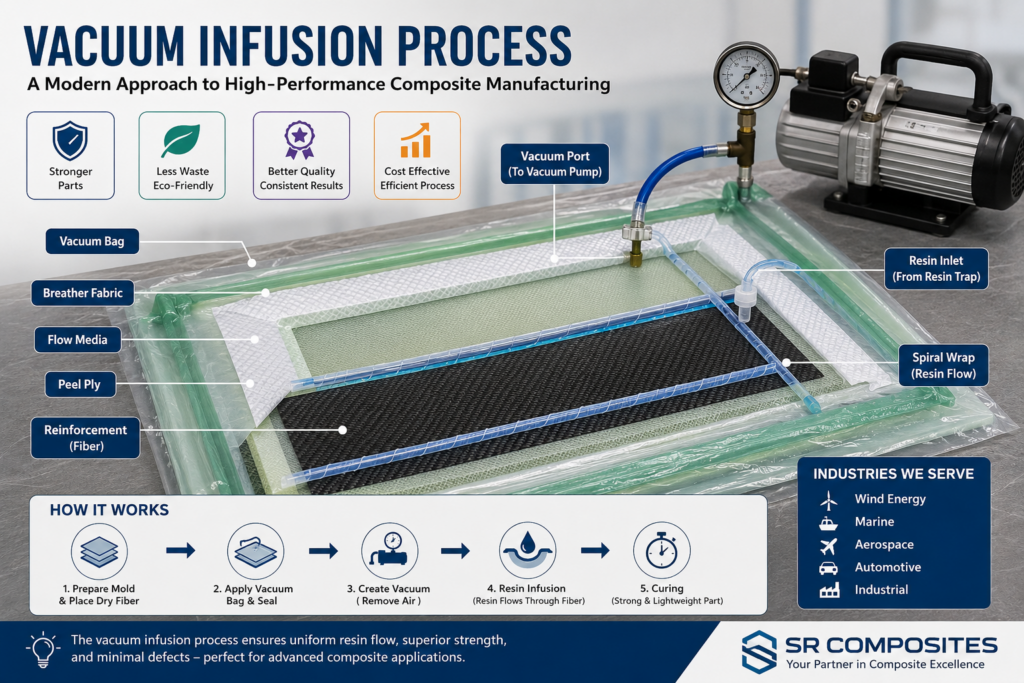
The vacuum is a closed-mold manufacturing method where dry fibers are placed in a mold and resin is pulled through them using vacuum pressure.
Instead of manual resin application, the system ensures controlled and even distribution across the material layers.
This makes the vacuum infusion process highly suitable for producing large and complex composite parts.
Why It Matters in Industry
Manufacturers prefer the vacuum infusion process because it improves product quality while reducing waste.
Key advantages include:
- Better fiber-to-resin ratio
- Lower air voids in final parts
- Consistent mechanical strength
- Cleaner and safer production
In real manufacturing environments, even small inconsistencies can affect performance, which is why the vacuum infusion process is widely adopted.
Step-by-Step Process
1. Mold Preparation
The mold is cleaned and coated for easy demolding.
2. Fiber Placement
Fiberglass or carbon fiber layers are arranged carefully.
3. Vacuum Sealing
A vacuum bag is placed to create an airtight system.
4. Flow Setup
Materials like peel ply and flow media are added to guide resin movement.
5. Vacuum Creation
Air is removed, compressing the fiber stack.
6. Resin Injection
Resin is drawn evenly through the fibers.
7. Curing
The material hardens into a solid composite structure.
Each stage of the vacuum infusion process ensures uniform quality and strength.
Applications
The vacuum infusion process is used in:
- Wind turbine blades
- Boat hulls and marine structures
- Aerospace components
- Automotive panels
- Industrial tanks
It is preferred wherever high strength and low weight are required.
Traditional vs Modern Methods
| Feature | Vacuum Infusion Process | Hand Lay-Up |
|---|---|---|
| Strength | High | Medium |
| Waste | Low | High |
| Quality | Consistent | Variable |
| Finish | Smooth | Rough |
| Control | Precise | Manual |
The vacuum infusion process clearly provides better consistency and efficiency.
Role of SR Composites
SR Composites (https://srcomposites.in/) supplies essential consumables used in the vacuum infusion process.
Their materials support proper resin flow, stable curing, and improved composite quality.
This helps manufacturers achieve better results in production environments where consistency is critical.
Government reference on composites and advanced materials (India):
CSIR–National Aerospace Laboratories (NAL) – Advanced Composites Research
According to research and development work by government institutions like CSIR–NAL, composite materials play a crucial role in improving the strength-to-weight ratio and performance in advanced engineering applications.
Featured Snippet
The vacuum infusion process is a closed-mold composite manufacturing method where resin is pulled into dry fiber materials using vacuum pressure, producing strong, lightweight, and high-quality composite parts with minimal defects.
FAQs
What is the vacuum infusion process used for?
It is used to manufacture strong and lightweight composite parts in industrial applications.
Why is it better than traditional methods?
It offers higher strength, lower waste, and better consistency.
What materials are used?
Fiberglass, carbon fiber, resin, and flow control consumables are used.
Where is it applied?
It is used in wind energy, marine, aerospace, and automotive industries.
Conclusion
The vacuum infusion process has become a key method in modern composite manufacturing due to its efficiency and reliability.
It ensures strong, lightweight, and high-quality components across multiple industries.
For reliable composite consumables used in the vacuum infusion process, visit https://srcomposites.in/
Ultimate Vacuum Infusion Guide: 7 Powerful Steps